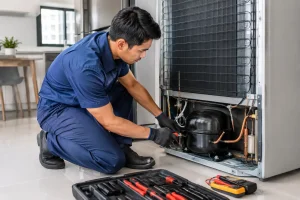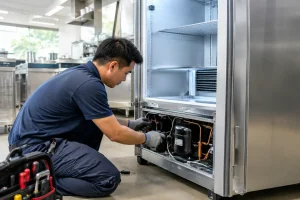
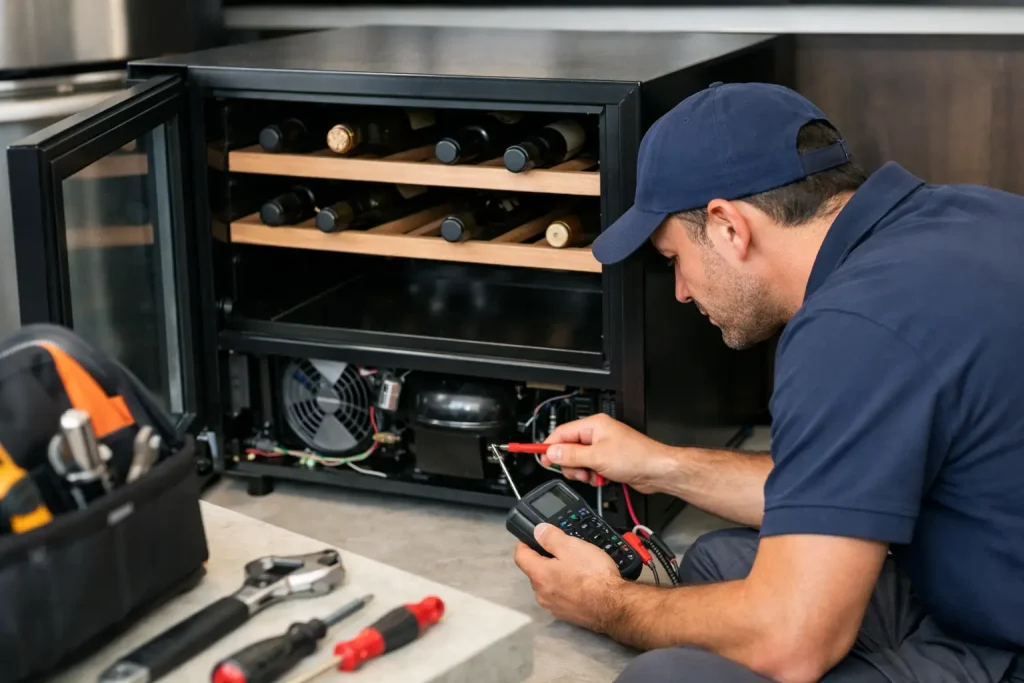
A wine chiller that suddenly feels warm can put an entire collection at risk, especially in Singapore’s hot, humid climate. Before assuming the appliance has failed, check whether the wine chiller is actually reaching its set temperature, whether its door is sealing properly, and whether airflow around the unit has been blocked. Some causes are simple to correct. Others need professional diagnosis before a small cooling issue becomes a costly compressor or control-board repair.
What Temperature Should a Wine Chiller Maintain?
Most wine chillers operate within a range of about 41°F to 64°F, depending on the model and whether it has one or two temperature zones. The ideal setting depends on what is stored inside, but stability matters more than chasing an exact number. A unit that repeatedly swings several degrees, runs continuously, or cannot cool below room temperature should be checked.
Give a newly installed or recently restocked chiller time to stabilize. Loading many room-temperature bottles at once forces the system to work harder, and it may take several hours to return to the selected temperature. However, if the display reads 50°F while the cabinet is clearly warm, or bottles feel noticeably warmer than expected after a full day, there may be a fault.
A separate thermometer placed inside the cabinet can help confirm the true temperature. Built-in displays can be inaccurate, particularly as the sensor ages. Keep the thermometer away from the rear wall and air vents, where readings may not reflect the average cabinet temperature.
Common Wine Chiller Problems and Their Likely Causes
The unit is running but not cooling
This is one of the most common wine chiller repair calls. When the fan or compressor can be heard but the cabinet stays warm, the problem may be restricted airflow, dirty condenser coils, a weak cooling fan, a faulty temperature sensor, or a failing compressor. In compressor-based models, a refrigerant leak or restriction in the sealed cooling system is also possible.
Start with the simple checks. Make sure the appliance is plugged in securely, the temperature setting has not been changed accidentally, and the rear or lower ventilation area is not pressed tightly against a wall. Freestanding wine chillers need clearance around their vents to release heat. If heat cannot escape, cooling performance drops and the compressor may run for long periods.
Do not remove sealed-system components or attempt to add refrigerant yourself. A leak must be properly located and repaired, and the system must be evacuated and recharged with the correct refrigerant quantity. This work requires suitable tools and experience.
The wine chiller is too cold or freezing bottles
A wine chiller that freezes bottles, forms ice, or cools far below its selected temperature often has a temperature-control issue. The thermostat, electronic sensor, control board, or damper system may not be responding correctly. In some models, ice buildup can interfere with airflow and cause uneven cooling.
Turn the unit off if bottles are freezing or there is significant ice around the internal panel. Once the appliance has fully defrosted, restart it and monitor the temperature. If the same issue returns, the control system should be tested. Repeatedly switching the appliance on and off at the wall is not a fix and can place extra strain on the compressor.
Water is collecting inside or underneath
Condensation is common in Singapore, especially when the door is opened often or the chiller is installed in a warm, poorly ventilated location. A small amount of moisture may be normal. Water pooling on shelves, dripping from the door, or collecting on the floor is not.
Check the door gasket for cracks, looseness, or dirt. A worn seal allows humid air into the cabinet, causing condensation and making the cooling system work harder. Also check that the appliance is level. If it leans too far forward or backward, the door may not close correctly and condensate may not drain as intended.
Some wine chillers use a drain channel and collection tray. A blocked drain, damaged tray, or excessive frost can cause water to overflow. A technician can inspect the drainage path and determine whether the moisture is caused by a simple blockage or a cooling fault.
The fan is loud, rattling, or not operating
Fans circulate cool air inside the cabinet and help remove heat from the condenser area. A rattling sound may come from a loose fan blade, packaging material, an uneven surface, or bottles touching the cabinet walls. A constant grinding or squealing noise can indicate a worn fan motor.
If the internal fan has stopped, some sections of the chiller may remain cool while others become warm. If the condenser fan fails, the compressor may overheat and cooling can deteriorate quickly. Avoid continuing to operate a unit that is excessively noisy or hot at the rear, as this may lead to more serious damage.
The display is blank, flashing, or showing an error code
An unresponsive display can be caused by a power supply problem, damaged wiring, failed control board, faulty sensor, or moisture affecting electronic components. First, confirm that the wall outlet is working by testing it with another suitable appliance. If the wine chiller uses a power strip or extension lead, connect it directly to a proper wall outlet where possible.
If an error code appears, take a photo before resetting the appliance. The code can help a technician identify whether the issue involves the sensor, fan, communication wiring, or control board. Repeated resets may erase useful symptoms without solving the underlying problem.
Safe Checks Before Booking Wine Chiller Repair
A few basic checks can save time and help identify the fault clearly. First, allow the wine chiller enough ventilation clearance and remove dust from accessible external vents using a soft brush or vacuum attachment. Switch off the power before cleaning near any fan opening or electrical area.
Next, inspect the door gasket. Close the door on a thin sheet of paper and gently pull it out. If it slides out easily in several places, the seal may be weak. Clean the gasket with a soft damp cloth, then check whether it sits evenly around the frame.
Also consider the installation location. A wine chiller placed beside an oven, under direct sunlight, or in a confined cabinet may struggle even when no part has failed. Built-in models and freestanding models have different ventilation requirements. A freestanding unit should not be installed tightly into cabinetry unless the manufacturer specifically states it is suitable for that use.
Finally, listen for changes in operation. A quiet hum and periodic fan noise are usually normal. Clicking every few minutes without cooling, persistent loud buzzing, or no sound at all despite a powered display are useful details to report during a service visit.
When Repair Makes More Sense Than Replacement
Many wine chiller faults are repairable, particularly worn door gaskets, fan motors, sensors, thermostats, switches, drainage issues, and certain control-board faults. Repair is often worthwhile when the cabinet is in good condition, the appliance is within a reasonable age range, and the required part is available.
Replacement may be the better option when there is a major sealed-system failure, extensive corrosion, repeated electronic faults, or a compressor problem in an older low-cost unit. The decision depends on the appliance’s age, condition, replacement part cost, and the expected remaining lifespan after repair. A proper diagnosis is more useful than replacing parts based on guesswork.
For built-in wine chillers, repairing the existing unit can be particularly practical because replacement may involve matching cabinet dimensions, door panels, ventilation requirements, and installation constraints. A technician should assess the appliance before it is dismantled or removed.
Preventive Maintenance for Better Cooling Performance
Wine chillers need less maintenance than many large appliances, but they should not be ignored. Keep the exterior vents clear, avoid overpacking bottles against internal air outlets, and clean the door gasket regularly. Dust buildup around the condenser area is more likely in homes and commercial spaces with heavy daily use, and it can reduce heat release over time.
Try not to open the door repeatedly for long periods. Each opening lets in warm, humid air, which increases condensation and forces the compressor to run longer. If your model has dual zones, avoid setting both sections to extreme temperatures unless needed, as wider demands can increase workload.
If the appliance will be unused for an extended period, empty it, switch it off, clean and dry the interior, and leave the door slightly open to prevent odor and mold. Do not store it in a damp area or place heavy objects on top of it.
When a wine chiller is no longer holding temperature, early diagnosis can protect the appliance and the bottles inside it. Fix It Appliance provides professional wine chiller troubleshooting and repair across Singapore, with practical advice on whether repair or replacement is the sensible next step.