
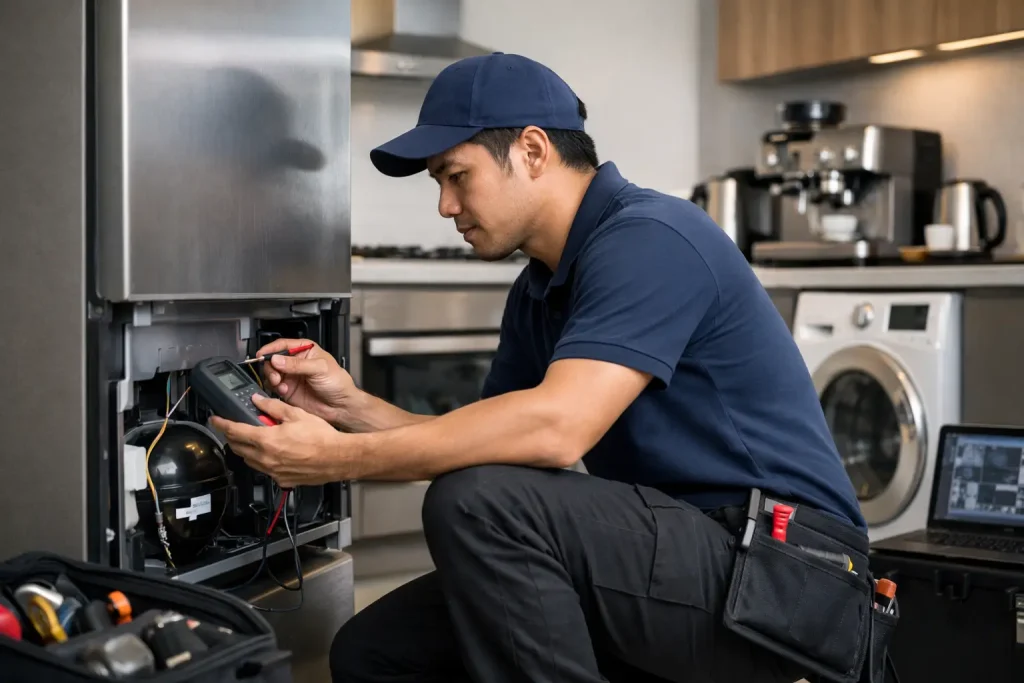
A refrigerator stops cooling before a busy weekend. A washer refuses to drain with a full load trapped inside. An oven trips the power right before service starts. In these moments, most people want the same thing – a clear answer fast. That is exactly how on-site appliance diagnosis works: a technician comes to your location, inspects the unit in real conditions, tests likely fault points, and identifies the most practical path to repair.
For homeowners and businesses, that process matters because appliance problems rarely happen at a convenient time. You need to know whether the issue is minor, whether parts are involved, how long the repair may take, and whether the appliance is worth fixing. A proper on-site diagnosis gives you those answers before unnecessary work begins.
Why on-site diagnosis matters
Appliances do not fail in a laboratory setting. They fail in kitchens, laundry areas, pantries, cafes, and utility rooms, often with real installation conditions affecting performance. A refrigerator may look like it has a compressor issue, but poor ventilation around the cabinet could be contributing. A washer may seem mechanically faulty, but a drainage restriction or water supply problem may be part of the picture. An oven may appear dead when the actual issue is with power delivery or a failed safety component.
That is why on-site diagnosis is more than a quick glance. It allows the technician to assess the appliance where it is used, under the conditions that produced the fault. This leads to a more accurate diagnosis and reduces guesswork.
For customers, the benefit is simple. You get a real assessment instead of assumptions. That helps avoid replacing parts that are not needed or making a decision based on incomplete information.
How on-site appliance diagnosis works step by step
It starts with the reported symptoms
The first stage is usually the problem description. Customers may report that the dryer is not heating, the fridge is leaking, the washing machine is noisy during spin, or the cooker hood has stopped extracting properly. These details matter because symptoms often narrow the fault path before testing even begins.
A good technician will usually ask when the problem started, whether it is constant or intermittent, and whether there were any warning signs beforehand. Strange sounds, burning smells, weak cooling, slow drainage, temperature swings, and error codes all help build the initial picture.
This part may seem basic, but it saves time. Many appliance faults have overlapping symptoms, so the sequence of events often points the technician toward the right components to inspect first.
A visual inspection comes next
Before opening panels or using test equipment, the technician typically checks the appliance’s general condition. That includes signs of wear, corrosion, loose fittings, damaged seals, blocked vents, poor leveling, water marks, or evidence of overheating.
This stage also helps identify issues outside the appliance itself. A washing machine can be affected by a kinked drain hose. A fridge may struggle because condenser airflow is restricted. A dryer may overheat if airflow is compromised. A cooker hood may appear weak because of buildup in the filter system.
Visual inspection is not guesswork. It is the fastest way to spot obvious causes, installation-related issues, and safety concerns before deeper testing starts.
Functional testing confirms what the appliance is doing
Once the technician understands the complaint and has checked the setup, the appliance is tested in operation when possible. This may involve running a wash cycle phase, checking whether a compressor starts, confirming heating response, monitoring airflow, or observing whether the appliance completes normal functions.
This matters because customer-reported symptoms and actual machine behavior are not always identical. A washer described as “not working” may still fill and agitate but fail only at the drain stage. A refrigerator reported as “not cold” may have a freezer section working while the fresh food section does not. An oven that “cuts out” may only fail after reaching a certain temperature.
Functional testing helps isolate the stage where the problem occurs. That saves time and avoids replacing parts based on broad symptoms alone.
Targeted electrical and component checks follow
After narrowing down the fault area, the technician moves into component testing. The exact checks depend on the appliance type, but the goal is the same: confirm whether a specific part has failed, is performing out of range, or is being affected by another fault.
For refrigerators, this may involve checking thermostatic controls, fans, sensors, defrost components, start devices, or compressor-related behavior. For washing machines, testing may focus on pumps, locks, inlet valves, motors, capacitors, or control boards. Dryers often require checks on heating elements, thermostats, sensors, motors, and airflow-related safety cutoffs. Ovens may need testing on igniters, heating elements, selectors, thermostats, fans, or control circuits.
This is where experience matters. A failed part is not always the root cause. Sometimes one faulty component causes another symptom. Sometimes multiple issues are present, especially in older units. A careful diagnosis distinguishes between the direct failure and the knock-on effect.
What the technician is really trying to determine
A proper diagnosis is not only about naming a bad part. It is about answering the practical questions that matter to the customer.
First, what has failed? Second, what repair is needed? Third, is the repair cost reasonable compared with the condition and age of the appliance? Fourth, can the issue be resolved on the same visit or will parts be required?
That last point is important. Some problems can be completed immediately if the needed part is available and the repair is straightforward. Others require ordering a specific component. Honest service means saying so clearly, not forcing a rushed fix or leaving the customer uncertain.
Why some faults take longer to diagnose
Not every appliance problem is obvious. Intermittent faults are the most challenging because the machine may behave normally during part of the visit. A refrigerator may cool inconsistently. A dryer may stop heating only after extended use. A washing machine may display an occasional error that does not appear every cycle.
In those cases, diagnosis can take longer because the technician must rule out several possibilities and work from evidence rather than assumptions. That may include checking operating history, wear patterns, and known fault behavior for that brand or model.
This is one reason transparent communication matters. A fast diagnosis is ideal, but an accurate one is more valuable than a rushed answer.
How pricing usually fits into the diagnosis process
Most customers want clarity on cost early, and rightly so. After diagnosis, the technician should be able to explain the issue in plain terms and outline the repair recommendation. If parts are needed, the estimate should reflect that. If the appliance is not economical to repair, that should also be stated plainly.
This is where trust is built. Honest diagnosis means no vague language, no pressure, and no inflated scope of work. Customers should understand what is wrong, why the repair is recommended, and what they are paying for.
For landlords, offices, restaurants, and other businesses, this clarity also helps with decision-making speed. Downtime affects operations, so a direct assessment allows repairs to move forward without unnecessary delay.
How on-site appliance diagnosis works for different appliance types
Refrigerators and freezers
Cooling problems are rarely solved by assumption. On-site diagnosis helps confirm whether the issue involves airflow, defrost failure, control faults, temperature sensing, or compressor-related performance. Leaks, unusual noises, and frost buildup also need real-condition inspection.
Washing machines and dryers
Laundry appliances often fail in specific cycle stages, so testing in place is important. Drainage, filling, spinning, heating, vibration, and door locking issues can each point to different faults. Installation conditions can also affect performance, especially with leveling and hose setup.
Ovens and cooker hoods
Heat inconsistency, no power, tripping, weak extraction, and excessive noise all benefit from on-site checks. With cooking appliances, safe operation is part of the diagnosis, not an afterthought.
What customers should expect from a good service visit
A good diagnosis visit should feel organized, not confusing. The technician should listen to the problem, inspect the appliance carefully, test what needs to be tested, and explain the findings clearly. If there are multiple repair options, those should be laid out in a practical way.
In Singapore, where homes and businesses rely heavily on working kitchen and laundry appliances in compact spaces, responsive service matters. Speed is important, but accuracy and honesty matter more. A rushed answer can waste time and money. A clear diagnosis gives you a solid decision point.
That is the real value of on-site diagnosis. It turns a stressful breakdown into a manageable next step, with facts instead of guesswork and a repair plan you can trust.


