A commercial ice machine that slows down or stops completely can disrupt daily operations quickly. This commercial ice machine repair review explains what a reliable repair service should check, which faults need urgent attention, and how to decide whether a repair is worthwhile for your equipment.
Commercial units work harder than small household ice makers. They may produce ice throughout the day in warm, humid conditions, which puts steady pressure on the water system, refrigeration components, fans, pumps, and controls. A small issue such as a blocked filter or worn water inlet valve can reduce output. Left unattended, it can also lead to a larger breakdown.
What a Commercial Ice Machine Repair Review Should Cover
A useful repair review is not simply a list of possible faults. It should explain the machine’s symptoms, identify the cause through proper testing, and set out the practical repair options. Replacing parts without confirming the underlying fault can waste time and money.
A technician should first check whether the unit has power, an adequate water supply, proper drainage, and enough airflow around the condenser. These basic conditions affect ice production more often than many owners expect. The technician should then assess the refrigeration circuit, circulation pump, water inlet system, ice thickness control, sensors, and control board where applicable.
The final recommendation should be clear. You should know which part has failed, whether the repair addresses the root cause, whether compatible spare parts are available, and whether preventive maintenance could reduce the chance of another stoppage.
Symptoms That Need Prompt Attention
Ice machines rarely fail without warning. A drop in production, thin or hollow ice, cloudy cubes, water leaks, unusual noise, or a machine that runs continuously are all reasons to arrange a diagnosis. Turning the machine off and on may temporarily reset a control fault, but it will not resolve a failing pump, blocked condenser, or refrigeration issue.
Act quickly if the unit is leaking near electrical components, tripping the circuit breaker, producing ice with an unusual odor, or showing an error code. Switch the machine off if there is a burning smell, exposed wiring, or a serious leak. These faults should not be handled by untrained staff.
Common Faults Found During Commercial Ice Machine Repairs
The exact problem depends on the ice machine type, age, maintenance history, and operating environment. Cube machines, flakers, nugget machines, and undercounter units use different mechanisms, but several faults are common across most brands.
A restricted water filter is one of the simplest issues. It can limit water flow, produce undersized ice, and make the machine take much longer to complete a cycle. A blocked water distribution system can create uneven ice formation. Mineral scale is a frequent cause, particularly where regular cleaning and descaling have been missed.
A faulty water inlet valve may prevent the machine from filling correctly. In some cases, the valve stays partly open and causes overflow. A worn circulation pump may reduce water movement over the evaporator plate, leading to incomplete or irregular ice. Drain pump faults can also cause water to back up or trigger safety shutdowns.
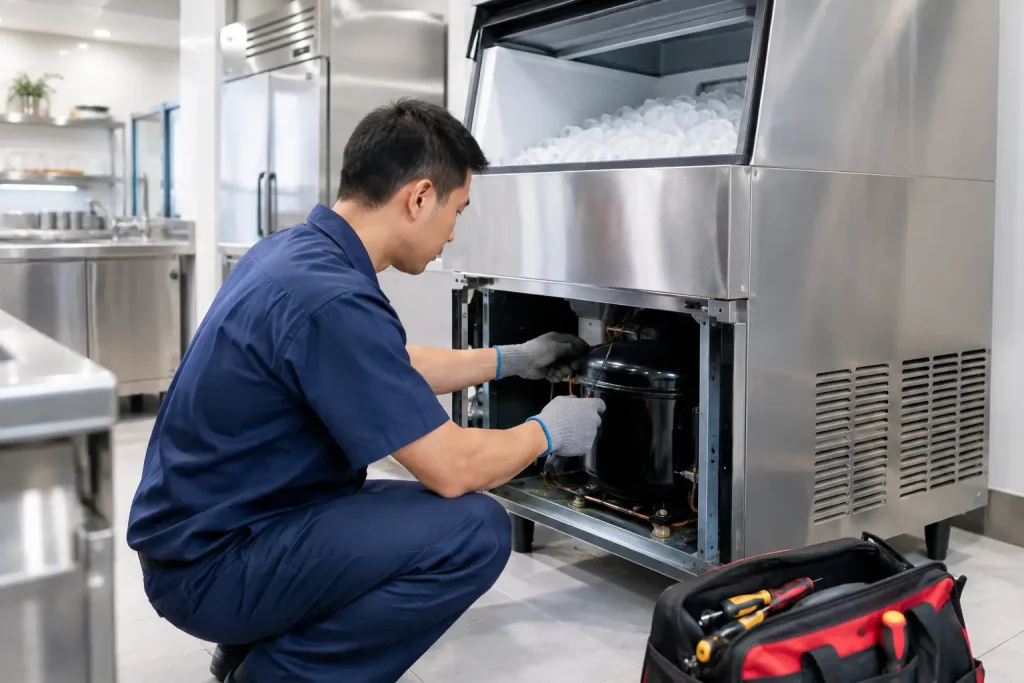
Refrigeration faults need more careful assessment. Dirty condenser coils, failed condenser fans, compressor problems, refrigerant leaks, and blocked components can prevent the machine from freezing water efficiently. These are not do-it-yourself repairs. Refrigeration work requires the correct tools, technical knowledge, and safe handling procedures.
Control-related faults can be less obvious. A defective thermistor, ice thickness probe, bin control, float switch, or circuit board may cause the machine to stop too early, keep running after the bin is full, or enter a fault mode. Testing individual components helps avoid replacing an expensive board when the actual problem is a smaller sensor or switch.
Repair or Replace: How to Make the Right Call
Repair is often the sensible choice when the machine is relatively new, the fault is isolated, and the main refrigeration system is in good condition. Replacing a pump, inlet valve, fan motor, sensor, or control component can restore reliable production without the cost and disruption of a new unit.
Replacement may be more practical when the machine has repeated major faults, has extensive corrosion, uses unavailable parts, or needs a costly compressor repair alongside other worn components. The decision also depends on downtime. If the unit is critical to your premises and has become unreliable, repeated repair visits may cost more in disruption than replacing it with a suitable model.
Before approving a major repair, ask for a straightforward explanation of the fault and the expected work. Consider the machine’s age, prior repair history, expected part availability, cleaning condition, and daily output needs. The cheapest option is not always the best value if it only delays another failure.
What Affects Commercial Ice Machine Repair Cost?
Repair costs vary because the parts and labor involved can be very different. Clearing a water blockage or replacing a small switch is generally less involved than diagnosing a refrigeration leak or replacing a compressor. Access can also affect the job. An undercounter machine installed in a tight service area may take longer to dismantle and test safely.
The main cost factors are the type of fault, model and brand, spare part price, machine location, extent of scaling or contamination, and whether more than one component has been damaged. A good service provider should diagnose before giving a final recommendation, rather than guessing based on a symptom alone.
Preventive maintenance is usually more manageable than emergency repairs. Regular servicing can identify restricted filters, scale buildup, dirty coils, worn pumps, and loose connections before they stop ice production entirely.
Maintenance That Helps Prevent Breakdowns
Daily and weekly care should follow the manufacturer’s guidance, but the basics are consistent. Keep the ice bin and exterior clean, use a dedicated scoop rather than hands or cups, and make sure air vents are not blocked by boxes or surrounding equipment. Check for water around the machine and investigate changes in ice size or production time early.
Scheduled cleaning is especially important in Singapore’s warm, humid environment. Scale and biofilm can build up in water circuits, while dust and grease can restrict condenser airflow. The cleaning interval depends on water quality, usage, machine design, and the environment where the unit operates.
For busy commercial equipment, a professional maintenance visit can include cleaning the water system, inspecting filters, clearing the condenser, checking pumps and valves, testing sensors, and confirming that the machine harvests and shuts down correctly. This is also a good time to identify parts that are beginning to wear.
Questions to Ask Before Booking a Repair
Choose a service that can explain the diagnosis in plain language. Ask whether the technician will inspect both the water and refrigeration sides of the machine, whether spare parts are available for your model, and whether the quoted repair includes testing after installation.
It is also reasonable to ask whether cleaning or maintenance is needed alongside the repair. For example, replacing a failed pump without addressing heavy scale buildup may shorten the life of the new part. A practical recommendation considers the condition of the whole machine, not just the part that triggered the callout.
Fix It Appliance provides diagnostics, spare parts replacement, and preventive maintenance for commercial ice makers and other appliances across Singapore. Prompt assessment helps businesses understand whether a fault can be repaired efficiently or whether replacement planning makes better sense.
Do not wait for a complete shutdown if your ice machine is producing less ice, leaking, or making unfamiliar sounds. Early diagnosis gives you more repair options and a better chance of keeping the machine dependable when you need it most.