
A refrigerator that suddenly feels warm can turn into an urgent problem within hours, especially in Singapore’s heat and humidity. This onsite refrigerator diagnosis guide helps you identify what you can safely check, what the symptoms may mean, and when a professional technician should inspect the appliance before the fault becomes more expensive.
Start With Food Safety and Basic Checks
If the refrigerator is not cooling properly, move perishable items to another working fridge, freezer, or cooler box as soon as possible. Do not rely on a fridge that feels only slightly cool. A refrigerator should generally maintain a temperature around 37-40°F, while a freezer should be close to 0°F.
Before assuming there is a major breakdown, check whether the appliance has power. Confirm that the display panel or interior light is on, the plug is firmly connected, and the wall outlet has not tripped. If the refrigerator shares an extension cord with other high-power appliances, remove that arrangement. Refrigerators should be connected directly to a suitable wall outlet.
Next, check the temperature setting. It is common for a setting to be changed accidentally during cleaning or when items press against a control panel. After adjusting the setting, allow several hours for the cabinet temperature to stabilize. Opening the door repeatedly during this period will slow recovery.
Onsite Refrigerator Diagnosis: What a Technician Checks
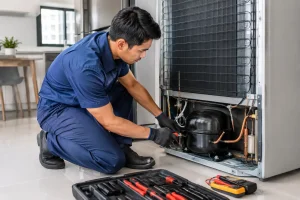
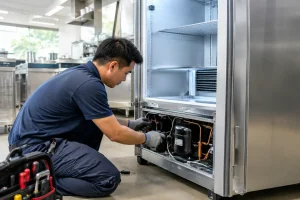
A proper onsite refrigerator diagnosis is more than checking whether the compressor makes a sound. The technician assesses cooling performance, airflow, electrical components, defrost operation, door sealing, and signs of refrigerant loss. The goal is to find the actual cause rather than replace a part based on one symptom alone.
Power, controls, and compressor operation
When the refrigerator has no lights, no display, and no sound, the cause may be a power supply issue, damaged cord, faulty control board, or failed electronic component. If lights work but the compressor never starts, the issue may involve the thermostat, start relay, overload protector, inverter board, or compressor itself.
A clicking sound every few minutes is a useful clue. It can indicate that the compressor is attempting to start but cannot continue running. This may be caused by a failed start component, an electrical fault, or a compressor problem. These parts should be tested with the right equipment. Replacing a relay without confirming the compressor condition can lead to unnecessary cost.
Airflow and evaporator performance
Most modern refrigerators circulate cold air from an evaporator section through fans and vents. If the freezer is cold but the refrigerator compartment is warm, blocked airflow is often the first area to inspect. Overpacked shelves, food placed directly in front of vents, or a failed evaporator fan can prevent cold air from reaching the fresh-food compartment.
A technician may remove internal panels to examine frost patterns on the evaporator coil. A coil covered in thick ice often points to a defrost fault, such as a failed heater, sensor, thermal fuse, or control board. A partially frosted coil may suggest a sealed-system issue, including a refrigerant leak or restriction. These faults require different repairs, so the frost pattern matters.
Door gaskets and cabinet sealing
Warm air entering through a poor door seal makes the compressor work longer and can create condensation, ice buildup, and weak cooling. Inspect the door gasket for tears, hardened sections, food debris, or corners that have pulled away from the door.
You can do a simple paper test by closing the door on a sheet of paper. If the paper slides out with almost no resistance at several points, the gasket may not be sealing properly. However, a poor seal can also result from a misaligned door or uneven refrigerator leveling. The gasket should not be replaced until the door position is checked.
Condenser condition and heat release
A refrigerator removes heat through its condenser, commonly located at the rear or beneath the unit. If the condenser is heavily coated with dust or the surrounding area has poor ventilation, the appliance may run for long periods and struggle to cool. Built-in and tightly fitted refrigerators are especially sensitive to restricted airflow.
For accessible models, light surface dust around external vents can be carefully removed after switching off the appliance. Do not bend coils, force tools into narrow openings, or remove rear covers unless you are qualified to do so. Internal components, wiring, and hot compressor parts can be damaged easily.
Match Common Symptoms to Likely Causes
Symptoms help narrow down the diagnosis, but they do not always prove one specific fault. Refrigerators from different brands use different layouts, sensors, and control systems. A technician will confirm the cause through testing.
The refrigerator is warm, but the freezer is cold
This often points to an airflow or defrost issue. Ice may be blocking the air channels, an evaporator fan may have stopped, or the damper that controls cold air to the refrigerator compartment may be stuck. In some models, a sensor or control board may be sending incorrect signals.
Avoid chipping ice with a knife or sharp object. One puncture to an evaporator coil can turn a repairable defrost problem into a sealed-system repair. A full manual defrost may temporarily restore cooling, but if the ice returns, the underlying defrost fault still needs attention.
The freezer is warm and ice is melting
Check that the door closes fully and that nothing is preventing the gasket from sealing. If the compressor is silent, clicks repeatedly, or runs continuously with little cooling, professional diagnosis is recommended quickly. Possible causes range from a failed start device to compressor or refrigerant system trouble.
A freezer that is only partly cold should not be ignored. The appliance may still sound normal while losing its ability to hold a safe temperature.
Water is leaking onto the floor
First, identify whether the water is clean and appears near the front, rear, or inside the refrigerator. Water inside the cabinet or under crisper drawers can be caused by a blocked defrost drain. Water near an ice maker or water dispenser may come from a loose connection, cracked tube, or faulty inlet valve.
Do not leave standing water near the plug or power outlet. Switch off the appliance if water is reaching electrical areas, then arrange an inspection. Leaks can damage flooring and may worsen if the refrigerator continues cycling.
The refrigerator is noisy
Some sounds are normal. A short hum, fan noise, water movement, and occasional clicks during defrost can occur during regular operation. Newer inverter models may also change compressor speed, so their sound can vary through the day.
Loud rattling may be caused by an unstable cabinet, objects vibrating on top of the fridge, or a drain pan that has shifted. Grinding, scraping, or high-pitched fan noise can indicate ice contacting a fan blade or a worn motor. If the sound is new, persistent, or accompanied by weak cooling, it is worth diagnosing early.
There is excessive frost or condensation
Frost around the freezer door, ice on packages, or beads of water inside the refrigerator usually indicate warm, humid air entering the cabinet. In Singapore, frequent door opening and poor gaskets can make this more noticeable. Check the seal, avoid placing hot items inside, and make sure the door is not being held open by containers or drawers.
Heavy frost on internal rear panels is more likely to involve the defrost system. Simply clearing visible ice may provide short-term relief, but recurring ice is a sign that a component should be tested.
When to Repair and When to Consider Replacement
Repair is often worthwhile when the refrigerator is relatively new, the cabinet and door seals are in good condition, and the issue is limited to a fan motor, sensor, defrost component, thermostat, relay, gasket, or water line part. These are common faults with targeted repair options.
Replacement may be more practical when an older unit has repeated major failures, severe rust, damaged insulation, or a failed compressor combined with sealed-system work. The decision depends on the refrigerator’s age, model, repair estimate, parts availability, and how reliably it has performed until now. Commercial refrigerators and wine chillers also need to be assessed against downtime costs, not just the repair price.
Ask for a clear diagnosis before approving major work. A reliable technician should explain the failed part, the recommended repair, whether spare parts are available, and any practical alternative if repair is no longer cost-effective.
What to Prepare Before an Onsite Visit
A few details can help speed up the diagnosis. Take note of the brand and model number, when the cooling problem started, whether the freezer is affected, and any error code shown on the display. If there is a leak, identify where water is collecting without moving the refrigerator unnecessarily.
Clear a small working area around the appliance if possible. For built-in units, let the technician know in advance, as access panels or installation details may affect the inspection. Avoid switching the refrigerator on and off repeatedly before the visit, unless there is an electrical smell, smoke, or water near electrical connections. In those cases, unplug it and leave it off.
Prompt diagnosis protects your stored items and prevents minor faults from becoming major repairs. For homeowners and businesses across Singapore, Fix It Appliance can assess the refrigerator onsite, explain the repair options clearly, and help bring the appliance back to reliable cooling.