A hob that suddenly will not heat can bring a busy household or commercial kitchen to a stop. For induction hob repair Singapore customers can rely on, the first step is identifying whether the problem is the cookware, the controls, the power supply, or an internal component that needs professional attention.
Induction hobs work differently from gas and conventional electric cooktops. Instead of heating a surface directly, they use an electromagnetic field to heat compatible cookware. This makes them fast and efficient, but it also means a small issue with the pan, sensor, cooling system, or control board can prevent a cooking zone from operating normally.
Common Induction Hob Faults
The hob has no power
If the display is completely blank, first check whether the appliance has power. A tripped circuit breaker, switched-off isolator, loose connection, or power supply fault can cause the hob to appear dead. If other appliances on the same circuit are also affected, the issue may not be inside the hob.
Do not remove the glass surface or access internal wiring yourself. Induction hobs contain high-voltage components, and some parts can retain an electrical charge even after the appliance is switched off. A technician can test the incoming supply and determine whether the fault is with the appliance or its dedicated circuit.
The hob turns on but will not heat
This is one of the most common calls for induction hob repair in Singapore. In many cases, the hob is working correctly but cannot detect the cookware. Induction-compatible pots and pans need a magnetic base. A simple check is to place a magnet against the underside of the pan. If it does not stick, the cookware is not suitable for induction cooking.
A pan that is too small, warped, or not centered on the cooking zone may also fail to activate. Try a different compatible pan before assuming the hob has failed. If several suitable pans are not detected, the cause may be a faulty pan sensor, induction coil, power module, or control board.
One cooking zone does not work
When the other zones still heat normally, the fault is often limited to one zone rather than the entire appliance. Possible causes include a damaged induction coil, a failed sensor, a loose internal connection, or a fault on the power board that controls that particular zone.
Avoid repeatedly switching the faulty zone on and off. If it produces a burning smell, unusual buzzing, sparking, or inconsistent heat, turn the hob off at the isolator and arrange a diagnosis. Continued use can damage connected components and may make a straightforward repair more costly.
The hob shuts off during cooking
Induction hobs have built-in safety features that can shut down a zone when overheating is detected. This may happen when ventilation below the hob is blocked, the cooling fan is not running properly, or internal components are overheating.
Spills around the control panel can also trigger erratic behavior. Wipe the surface with a soft, dry cloth and allow it to dry completely before trying again. If the hob continues to switch off after a short period of use, professional troubleshooting is advisable. A technician can inspect the cooling fan, temperature sensors, power module, and ventilation clearance.
Error codes, beeping, or locked controls
An error code is useful information, not just an inconvenience. It can point to overheating, pan detection failure, communication problems between boards, or a sensor fault. The meaning varies by brand and model, so record the exact code before resetting the unit.
For a child lock or control lock, refer to the appliance manual for the correct button combination. If the controls remain locked, beep continuously, or change settings without being touched, moisture, a damaged touch-control panel, or an electronic control fault may be involved.
Safe Checks Before Booking a Repair
There are a few practical checks you can make without opening the appliance. Confirm that the hob is switched on at its isolator, check the circuit breaker, and test the affected zone with a flat, induction-compatible pan. Clean and dry the glass surface, especially around touch controls, and allow the hob to cool fully if it shut down during use.
You can also note what happened before the fault appeared. Did the problem start after a power trip, a spill, heavy cooking, or cleaning? Does it affect one zone or all zones? Does an error code appear? These details help speed up appliance diagnostics and reduce guesswork during the service visit.
Do not use a cracked glass surface, even if the hob still heats. Cracks can worsen with heat and may expose internal components to moisture. Likewise, do not attempt to replace an induction coil, fuse, control board, or cooling fan without the correct training and equipment.
What Happens During Professional Induction Hob Repair Singapore Service
A proper repair begins with diagnosis, not immediate parts replacement. The technician checks the power supply, visual condition of the glass, control response, error codes, cookware detection, cooling fan operation, and heating performance of each zone.
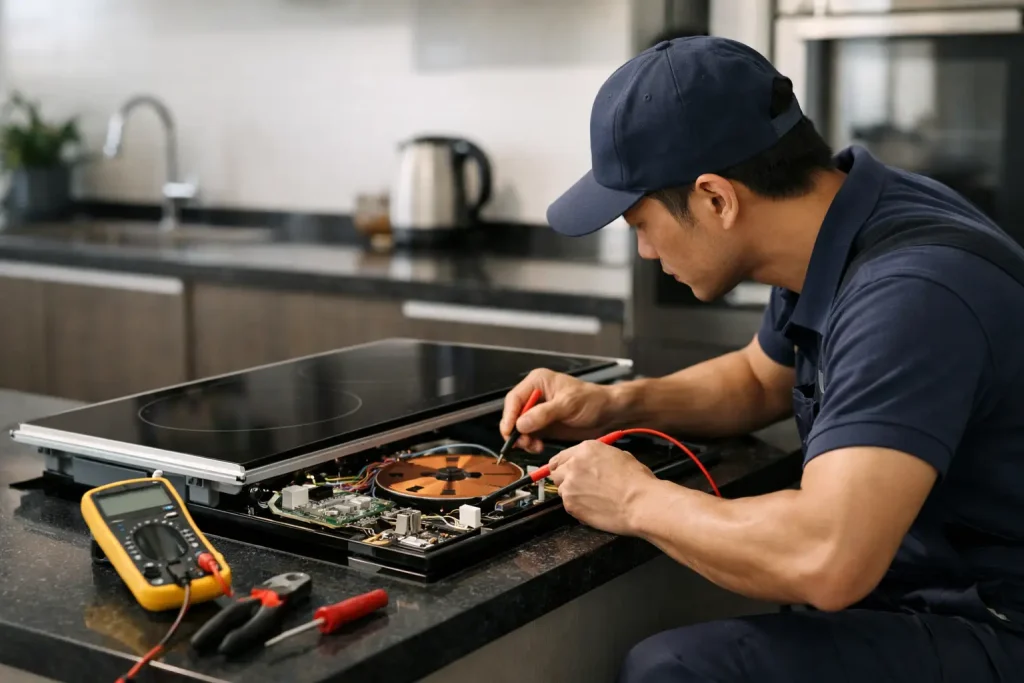
If an internal fault is suspected, the appliance is isolated before the necessary panels are removed. Components may be tested to identify whether the issue lies with the induction module, touch-control board, thermal sensor, fan, wiring, or another part. This matters because similar symptoms can have very different causes. A hob that will not heat may need a compatible pan, while another with the same symptom may have a failed power board.
Once the fault is confirmed, the repair options should be explained clearly. Some parts can be replaced quickly if available, while specialized boards or model-specific components may require ordering. For built-in hobs, careful dismantling and reinstallation are also important to avoid damaging the countertop or the appliance frame.
Induction Hob Repair Cost in Singapore
Repair cost depends on the brand, model, built-in configuration, fault type, and spare part required. A simple issue such as a loose connection, minor control problem, or fan replacement is usually less expensive than replacing an induction power module or main electronic board.
The age of the hob also matters. Older models may have limited spare parts availability, while premium models can use more expensive boards and sensors. An honest assessment should consider both the repair cost and the likely remaining service life of the appliance.
A repair is often worthwhile when the glass is intact, the hob is otherwise in good condition, and the failed part is available at a reasonable cost. Replacement may be the better choice when there is severe glass damage, repeated board failures, major corrosion from liquid ingress, or an obsolete model with unavailable parts.
For landlords, property managers, and businesses, downtime is another consideration. A reliable repair may be preferable when it restores service quickly and avoids the disruption of selecting, fitting, and testing a replacement built-in hob.
Preventing Future Hob Problems
Induction hobs need little day-to-day maintenance, but a few habits can prevent avoidable faults. Use cookware with a clean, flat magnetic base, and avoid dragging heavy pans across the glass. Clean spills promptly after the surface cools, using products suitable for ceramic or induction glass.
Keep the ventilation area beneath the hob clear. Heat needs a path to escape, particularly with built-in units. If the cooling fan becomes noisy, runs unusually long, or stops running altogether, have it checked before overheating damages more expensive components.
Avoid placing wet cloths, utensils, or objects over the touch controls. Moisture and accidental activation can cause beeping, lockouts, or unexpected settings changes. After a power interruption, check that the clock, lock setting, and cooking zones respond normally before relying on the appliance for a busy meal service.
When your hob shows repeated errors, heats unevenly, or fails to recognize compatible cookware, prompt diagnosis is usually the sensible next step. Fix It Appliance provides professional induction hob troubleshooting and repair across Singapore, helping households and businesses make a clear repair-or-replace decision based on the actual fault.