When an oven stops heating before dinner service or halfway through a family meal, the question is rarely academic. Gas oven vs electric oven repair becomes a practical decision about cost, downtime, safety, and how quickly normal routine can return.
For most property owners and businesses, the right choice is not about which oven type is better in theory. It is about which faults are common, which repairs are straightforward, and what kind of service risk comes with each system. Gas and electric ovens fail in different ways, and that matters when you are deciding whether to repair the unit you have, replace a part, or move on from the appliance entirely.
Gas oven vs electric oven repair: what changes?
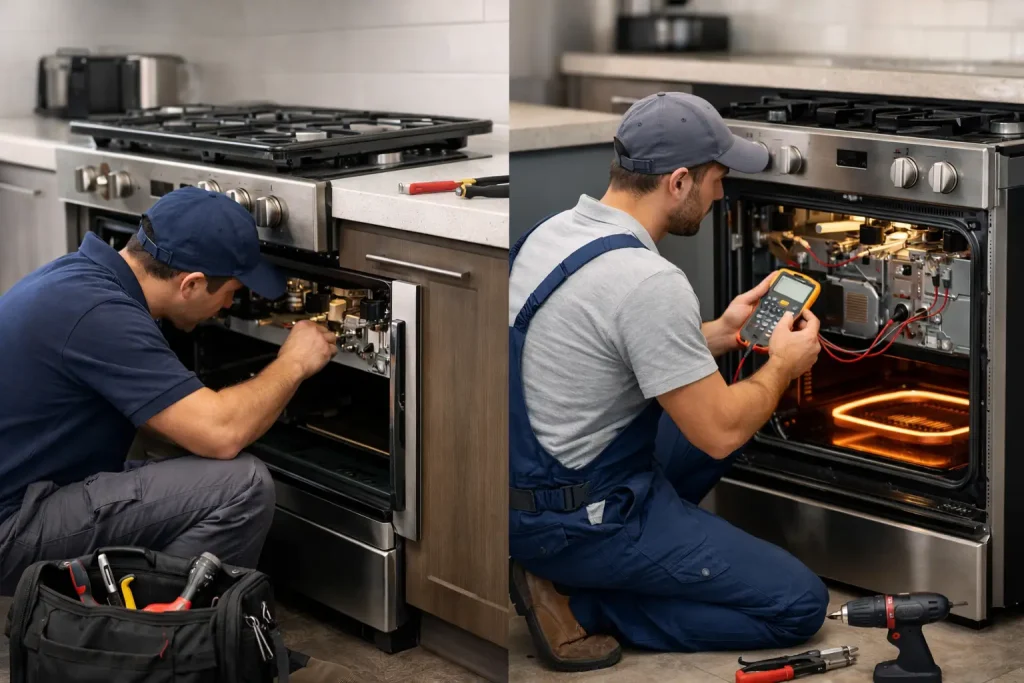
The biggest difference is the system doing the heating. A gas oven depends on ignition, gas flow, burner performance, and safety components that regulate flame. An electric oven depends on heating elements, wiring, sensors, switches, and control boards. That one distinction affects diagnosis time, part cost, safety procedures, and the type of fault you are most likely to face.
Gas oven repairs often involve ignition failure, weak or uneven flame, gas valve problems, or thermostat-related heating issues. Electric oven repairs more often involve a burned-out bake element, faulty top element, temperature sensor failure, tripped thermal protection, or a control board problem. Neither category is automatically cheaper every time. It depends on which component has failed and whether the oven has one clear fault or several age-related issues happening at once.
If your priority is predictable heating performance, electric ovens tend to show more obvious failure patterns. If your priority is lower running cost or strong heat response, gas ovens may still be worth repairing when the fault is isolated. The repair decision is usually easier when the diagnosis points to one failed part instead of a chain of wear across multiple components.
Common gas oven faults and repair outlook
Gas ovens often give warning signs before total failure. You may notice delayed ignition, a clicking sound without flame, food cooking unevenly, a gas smell, or heat that drops off during use. Those symptoms point to a smaller group of likely causes, which can help keep the repair process focused.
A weak igniter is one of the most common issues. In many cases, the oven may click and eventually light, or it may fail to light at all. This type of repair is often worthwhile because the fault is specific and the replacement part is known. Burner issues, clogged ports, and thermostat problems can also be practical to repair when the rest of the oven is in stable condition.
The more serious concern with gas ovens is safety. If there is any smell of gas, inconsistent flame behavior, or signs that the appliance is not regulating properly, the urgency is higher. A gas-related fault is not just a convenience issue. It can affect safe operation and should be assessed quickly.
That does not mean gas ovens are always harder to repair. In many cases, they are very repairable when the problem is isolated to ignition or burner-related components. The key point is that diagnosis needs to be accurate. Replacing the wrong part wastes time and keeps the oven out of use longer.
Common electric oven faults and repair outlook
Electric ovens are usually more straightforward when it comes to visible heating faults. If the oven powers on but does not heat, or heats unevenly, the cause is often tied to the bake element, broil element, sensor, fuse, or control system. Many of these issues can be identified quickly because the failure pattern is easier to trace.
A damaged heating element may show visible blistering or breakage, but not always. Sometimes the problem is internal, and the oven simply cannot reach temperature. In other cases, the oven overheats, shuts off too early, or displays error codes that suggest a sensor or electronic control problem.
Electric oven repair can be cost-effective when the failed component is mechanical or isolated, such as an element or sensor. It becomes less attractive when the issue involves a costly control board in an older oven, especially if replacement parts are limited or if the appliance already has door seal wear, hinge problems, or inconsistent performance across multiple functions.
For homes and small businesses that rely on stable, repeatable temperatures, electric ovens can be easier to evaluate from a repair standpoint. The trade-off is that electronic faults can become expensive on premium or older models.
Which is usually cheaper to repair?
There is no honest one-line answer here. Gas oven vs electric oven repair costs depend more on the failed part than the fuel type alone.
A gas oven igniter replacement may be a sensible repair. A gas valve issue may be less appealing if the unit is already old. An electric bake element replacement may be relatively straightforward. A failed electronic control board may push the numbers higher than expected. Labor can also vary based on access, built-in installation, brand design, and whether the fault is confirmed quickly or requires deeper troubleshooting.
In practical terms, electric ovens often have lower-complexity repairs when the issue is limited to elements or sensors. Gas ovens can also be economical to repair when ignition or burner components are the problem. Costs climb on both sides when the fault involves major controls, multiple worn parts, or poor parts availability.
This is why transparent diagnosis matters more than broad assumptions. A service visit should give you a clear explanation of the fault, the expected repair scope, and whether the money makes sense relative to the oven’s age and condition.
Safety matters more with gas faults
Every oven issue is inconvenient, but not every issue carries the same level of risk. An electric oven with a failed element may stop heating and disrupt your day. A gas oven with ignition trouble or gas odor raises a different concern.
That is one reason gas oven service should be handled with urgency when symptoms point to leakage, incomplete ignition, or unstable flame. For landlords, restaurants, and property managers, this is not just about getting the oven working again. It is about restoring safe operation and reducing liability.
Electric ovens are not risk-free. Faulty wiring, overheating, damaged insulation, or a failing control board can also create safety concerns. But in day-to-day service calls, gas-related symptoms usually demand faster attention because the consequences of delayed action can be more serious.
When repair makes sense and when it does not
Repair usually makes sense when the oven has been reliable, the fault is isolated, and the part cost is reasonable for the appliance’s age. That applies to many gas igniter problems and many electric element or sensor failures.
Repair becomes harder to justify when the oven has recurring breakdowns, inconsistent temperature control, multiple worn components, or expensive electronic failures on an older model. If a business depends on the oven daily, downtime also has a real cost. A cheaper repair is not always the better decision if reliability remains doubtful afterward.
Built-in ovens are often worth closer consideration before replacement because installation changes can add cost and delay. In those cases, a solid repair may be the faster and more economical path, especially if the rest of the unit is in good shape.
For customers in Singapore, response speed also matters. If an oven is essential for food service, tenant turnover, or household routine, the value of a prompt and accurate repair is not just the invoice amount. It is the reduction in disruption.
Choosing service based on oven type
A good repair experience starts with proper diagnosis, but it also depends on whether the service approach fits the appliance. Gas ovens require attention to combustion, ignition, and regulation. Electric ovens require careful testing of elements, sensors, and controls. The tools and thought process are different.
That matters for homeowners, but even more for restaurants, cafes, offices, and landlords managing multiple appliances. Fast attendance is useful, but accurate fault finding is what saves money. Honest service means being told when the repair is worth doing and when it is not.
At Fix It Appliance, that practical approach is the standard customers usually want most – clear diagnosis, transparent pricing, and work that restores normal use without unnecessary upselling.
Gas oven vs electric oven repair: the better choice depends on the fault
If you are comparing gas oven vs electric oven repair from a maintenance point of view, electric models often have more predictable failure patterns, while gas models demand more caution when symptoms affect safe operation. If you are comparing from a cost point of view, both can be reasonable to repair when the problem is specific and the appliance is otherwise sound.
The most useful question is not whether gas or electric is better overall. It is whether your oven has a repairable fault, whether the repair cost matches the oven’s remaining value, and whether the result will be dependable enough for your daily needs.
When the diagnosis is clear, the decision usually becomes clear too. A reliable repair should bring your oven back to life, lower your stress, and let you get back to cooking without second-guessing the appliance every time you turn it on.