
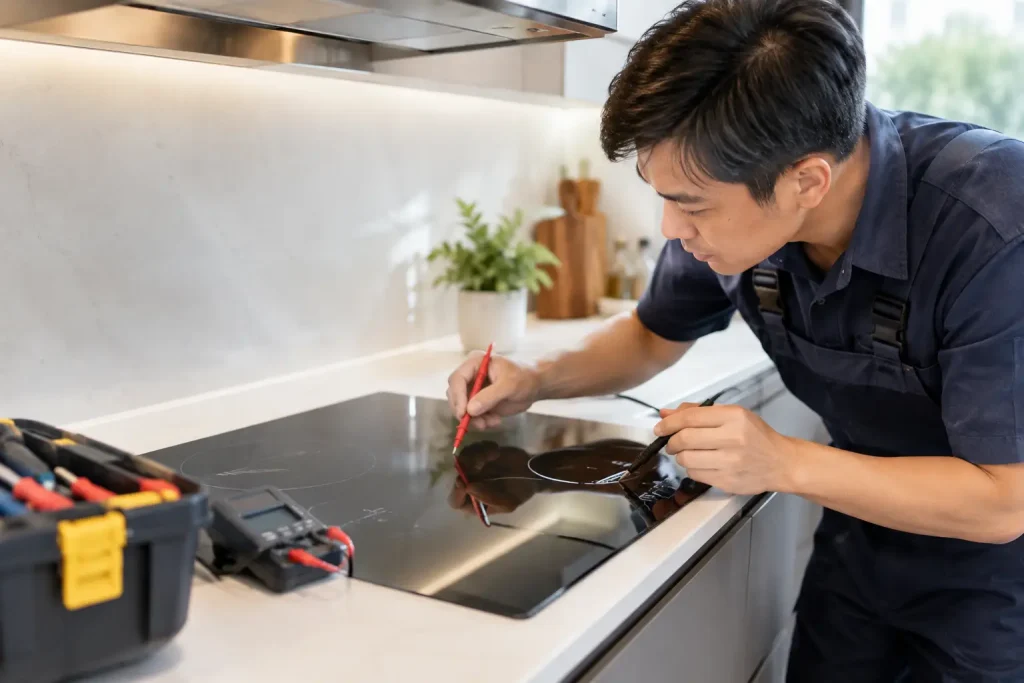
An induction hob that suddenly beeps, displays a letter and number, or refuses to heat can interrupt a busy household or commercial kitchen. Before you troubleshoot induction hob errors, stop cooking, switch off the affected zone, and check whether the glass surface is cracked, unusually hot, or giving off a burning smell. Those signs require professional attention rather than repeated resets.
Many induction hob faults look similar at first. A pan may not be detected, a zone may switch itself off, or the whole appliance may appear dead. The difference often comes down to cookware, ventilation, the control lock, power supply, or a failed internal component. A few safe checks can narrow down the cause and help you decide whether a repair call is needed.
Start With the Error Code and What Happened Before It
If a code appears on the display, take a photo before turning the hob off. Error codes differ by brand and model, so an E code on one cooktop may mean something completely different on another. The appliance model number, usually found on the underside of the hob or in its manual, is just as important as the code itself.
Think about what happened immediately before the fault. Did liquid spill over the touch controls? Did the problem begin after a power trip? Does it occur only on one cooking zone, or all zones? Is the hob installed above a built-in oven or drawer? These details help separate a simple operating issue from a fault involving sensors, cooling fans, power boards, or induction coils.
A brief reset can clear a temporary control error. Turn the hob off at its dedicated isolator or circuit breaker, wait five to ten minutes, then restore power. Do this once only. If the same code returns, avoid repeatedly cycling the power. Persistent errors are usually the appliance telling you that a component needs inspection.
Common Induction Hob Errors You Can Check Safely
The hob does not detect the pan
A flashing symbol, repeated beeping, or no heat while the display is on commonly means the pan is not being recognized. Induction zones need cookware with a magnetic base. Test the base with a small magnet. If it does not stick firmly, the pan will not work on an induction hob.
Even compatible cookware can cause problems if the base is warped, too small for the zone, or not centered. A small pot placed on a large zone may not be detected. Try one known-good, flat-bottomed magnetic pan on a different zone. If that pan works elsewhere but not on one zone, the issue may be with that zone rather than the cookware.
Do not place foil, cutlery, lids, or empty cookware on the surface to test it. They can heat unexpectedly or trigger safety protection.
The hob turns off during cooking
Induction cooktops are designed to switch off when they detect overheating, extended unattended operation, or unsuitable cookware. A zone that shuts down after several minutes may be protecting itself because heat cannot escape properly from underneath.
Check that the ventilation openings around the hob installation are not blocked by stored items in the cabinet below. If the cooling fan runs loudly, runs continuously after cooking, or does not run when the hob becomes hot, internal servicing may be required. A fan fault can lead to overheating errors and repeated shutdowns.
Heat and moisture can also affect the touch-control area. Dry the glass thoroughly with a soft cloth and make sure no pan, cloth, or utensil is resting across the control panel. If the controls continue to activate by themselves or do not respond after drying, switch off the appliance at the isolator and arrange a diagnosis.
The control lock will not turn off
A key, padlock, or L symbol usually indicates that the child lock or control lock is active. Most models require you to touch and hold the lock symbol for several seconds, but the exact method varies. Refer to the model instructions if available rather than pressing multiple buttons at random.
If the lock remains active after a proper reset, or the display changes without input, the touch-control board may be affected by moisture, residue, or a component fault. Avoid using excessive water or spray cleaner directly on the panel. Apply a small amount of suitable hob cleaner to a cloth instead.
The hob is completely dead
When no display lights up, first check whether another appliance on the same circuit has lost power. Check the dedicated cooker switch or isolator is on and look for a tripped breaker. If the breaker trips again after being reset, leave it off. Repeated tripping can indicate a wiring, power module, or internal insulation fault.
A dead hob after a power outage may occasionally recover after a controlled reset. However, if the appliance has no response while the rest of the kitchen power is normal, it needs professional testing. Built-in induction hobs use high-voltage components and capacitors that can retain a dangerous charge even after power is switched off. Do not remove the glass top or attempt internal repairs.
When an Error Points to a Repair Rather Than a Reset
Some symptoms should move straight from troubleshooting to a service appointment. These include a cracked ceramic glass surface, a burning odor, sparks, repeated power trips, a loud buzzing that is new or unusually strong, or an error code that returns every time the hob is used.
A faint hum, clicking during power adjustment, or a cooling fan continuing for a short time after cooking can be normal. Induction technology creates magnetic energy, and certain pans are noisier than others. The concern is a sudden change in sound, especially when paired with poor heating, error messages, or intermittent shutdowns.
One faulty zone often suggests a damaged induction coil, temperature sensor, or connection. Errors affecting every zone are more likely to involve the main power board, supply issue, control board, or cooling system. This is not a rule for every model, but it helps set expectations before diagnosis.
For landlords, property managers, cafés, and offices, record the code, appliance model, and whether the fault affects all zones. This can reduce downtime because the technician can assess likely parts requirements before arriving. In a commercial setting, do not keep using the remaining zones if the unit is overheating or tripping power. A small fault can become a more expensive board failure when the hob is repeatedly stressed.
What a Professional Induction Hob Diagnosis Involves
A proper induction hob repair is more than clearing an error code. The technician should check the power supply to the appliance, inspect the condition of the glass and touch controls, test cooling operation, and identify whether the fault lies with a coil, sensor, wiring connection, or electronic module.
Spare parts availability matters. Common replacement parts may include cooling fans, touch-control assemblies, induction coils, temperature sensors, and power boards. The right repair option depends on the hob’s age, brand, model, fault type, and the cost of the required part. A fan or sensor replacement can often be worthwhile, while an older hob needing a costly control and power module may deserve a repair-versus-replacement discussion.
Do not approve a generic replacement board without confirming the exact model and part number. Induction hobs can look alike while using different electronics, software versions, and wiring layouts. Accurate diagnosis prevents unnecessary parts costs and repeat visits.
Prevent Future Induction Hob Faults
Use flat, induction-compatible cookware and keep the base clean and dry. Wipe spills from the touch-control area promptly once the surface is safe to touch. Do not cover ventilation spaces below the hob, and avoid lining the area beneath it with items that restrict airflow.
Treat the glass surface carefully. Sliding rough pans, dropping heavy cookware, and using the hob as a storage surface can damage the ceramic glass or touch controls. A cracked surface should never be ignored, even if the hob still heats. Moisture can reach internal components through the damage.
If your induction hob shows the same error more than once, early diagnosis is usually the practical choice. Fix It Appliance provides professional induction hob troubleshooting and repair across Singapore, helping homeowners and businesses identify the fault clearly and make a sensible repair decision before a minor issue stops the kitchen completely.


