
A refrigerator that is no longer cold, a washer that stops mid-cycle, or an oven that will not heat turns a simple service search into an urgent decision. An onsite appliance repair review can help, but only when you know what the review is actually telling you. A high rating is useful. Clear details about diagnosis, pricing, punctuality, and whether the appliance stayed fixed are far more useful.
For homes and businesses in Singapore, the right repair service is not simply the first technician who can arrive. It is one that can identify the actual fault, explain the options in plain language, use suitable parts, and carry out the work safely at your location.
What an Onsite Appliance Repair Review Should Tell You
The best reviews describe the repair experience from start to finish. Look beyond comments such as “good service” or “fast response.” They may be genuine, but they do not tell you whether the technician handled a difficult fault properly or whether the customer understood the charges.
A useful review usually mentions the appliance type and the symptom. For example, “the refrigerator was running but not cooling,” “the dryer had no heat,” or “the dishwasher was leaking from the base.” This level of detail suggests the reviewer had a real service experience and gives you a better indication of whether the company works on appliances similar to yours.
Pay attention to comments about diagnosis. Many appliance faults have similar symptoms but different causes. A washing machine that will not drain may have a clogged filter, a blocked drain hose, a worn pump, or an electronic control issue. A technician should test the appliance before recommending a replacement part. Reviews that mention a clear explanation of the fault are generally more valuable than reviews focused only on speed.
You should also look for feedback on communication. Reliable onsite repair involves confirming the appointment, explaining any diagnostic or transport-related limitations, and telling the customer if a part must be ordered. Same-day repair is possible for many common faults, but it is not realistic in every case. A specialized control board, compressor component, door seal, or model-specific heating element may not be immediately available.
Signs of a Reliable Onsite Repair Service
A strong repair service should make the process easy to understand without making promises that cannot be kept. Before booking, check whether the provider works on your specific appliance category and whether it handles your brand or model. Refrigerator, wine chiller, washer, dryer, dishwasher, oven, microwave, induction cooktop, cooker hood, freezer, coffee machine, and ice maker repairs require different experience and spare parts.
A professional technician will normally ask a few questions before arriving. They may request the brand, model number, age of the appliance, error code, and a short description of the issue. This is not unnecessary delay. It helps them bring likely tools and common parts, reducing the chance of a second visit.
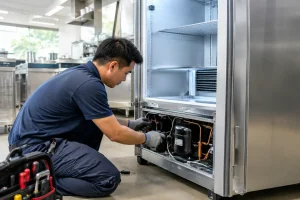
Good reviews often highlight a technician who arrives prepared, protects the work area where practical, and tests the appliance after repair. For built-in ovens, hobs, dishwashers, and integrated refrigerators, access can affect the time required. The technician may need room to inspect connections, remove panels, or safely pull the appliance forward. Clear expectations are a sign of honest service, not poor service.
Clear pricing matters more than the lowest quote
Low advertised prices can be attractive when an appliance fails unexpectedly. However, an onsite repair price may include a diagnostic fee, labor, replacement parts, and, in some situations, additional work needed to access a built-in unit. Ask what is included before confirming the booking.
A trustworthy provider should explain the cost once the fault is diagnosed and before proceeding with chargeable repairs. If a part is required, ask whether it is original, compatible, or refurbished, if applicable. The right choice depends on availability, appliance age, cost, and the importance of long-term reliability.
Do not assume that the cheapest option is the best value. A low-cost repair that uses an unsuitable part or addresses only a symptom can lead to another breakdown soon after. On the other hand, a costly repair is not automatically the right answer for an older appliance with several worn components. The key is getting an informed recommendation.
Look for evidence of accountability
Reviews are most reassuring when they mention follow-up support, a repair warranty where applicable, or a company that returned to resolve an issue. Appliances can develop unrelated faults after a repair, particularly when they are old or heavily used. What matters is whether the provider distinguishes between a new issue and work covered by the original repair.
Be cautious with reviews that make absolute claims without details, especially if every comment uses similar wording. Genuine feedback usually varies. One customer may value a quick appointment, while another may appreciate a technician who explained why a freezer was icing up or why a dryer needed better airflow.
Questions to Ask Before You Book
A short call or message can prevent confusion later. Start by confirming that the company provides onsite service in your area of Singapore and repairs your appliance type. Then provide the model number if it is available. This is usually found on a label inside a refrigerator compartment, around a washer door frame, on the side or back of an appliance, or in the user manual.
Ask whether there is a diagnostic charge and whether it is separate from repair labor. If your appliance displays an error code, share it, but do not treat the code as a final diagnosis. For example, an oven temperature fault can be caused by a sensor, heating element, wiring issue, thermal cutout, or control board. Proper testing still matters.
It also helps to ask what happens if the appliance is not economical to repair. A professional technician should be able to explain the likely repair cost, the condition of the unit, and whether replacement makes more sense. This is especially relevant for older refrigerators with cooling-system faults, badly corroded appliances, or units requiring expensive electronic boards.
How to Prepare for an Onsite Appliance Repair Visit
Simple preparation can help the technician diagnose the problem faster. Keep the appliance connected unless it is unsafe to do so, and take note of when the fault occurs. Does the washing machine stop only during spin? Does the fridge cool poorly only in the afternoon? Does the oven trip when a particular function is selected? These details are useful.
Clear a reasonable path to the appliance and remove items that block access. For a refrigerator or freezer, protect perishable items if cooling has already failed. For a washer or dishwasher with an active leak, turn off the water supply if you can do so safely and avoid running another cycle. If you smell burning, see scorch marks, or notice repeated electrical tripping, switch off the appliance and arrange professional assessment rather than testing it repeatedly.
Do not dismantle panels, force doors, or install parts based only on an online guess. A loose connection or blocked filter can be simple, but incorrect handling can damage plastic clips, seals, wiring, or electronic controls. It may also make diagnosis less straightforward when the technician arrives.
Repair or Replace: What Reviews Cannot Decide for You
Even the most detailed onsite appliance repair review cannot determine whether your appliance is worth repairing. That decision depends on the fault, appliance age, condition, part availability, and the cost of repair compared with a suitable replacement.
Repair is often sensible when the appliance is otherwise in good condition and the issue is a serviceable component, such as a drain pump, door lock, thermostat, fan motor, heating element, seal, or switch. Preventive maintenance may also extend the life of appliances affected by clogged filters, poor ventilation, worn door gaskets, or accumulated lint.
Replacement may be the better option when a major component has failed on an aging unit, repairs are likely to be repeated, or essential parts are no longer available. For commercial users, downtime also matters. A short-term appliance rental option may help maintain operations while a repair is assessed or a replacement is arranged.
Fix It Appliance approaches onsite repairs with the practical goal of finding the fault first, then giving customers a clear repair recommendation. The aim is not to push a repair at every cost. It is to help you make a workable decision based on the condition of the appliance and the repair required.
When reading reviews, choose detail over hype. The right service should leave you knowing what failed, what was repaired, what it cost, and what you can do to reduce the chance of the same problem returning. That clarity is often the strongest sign that your appliance is in capable hands.