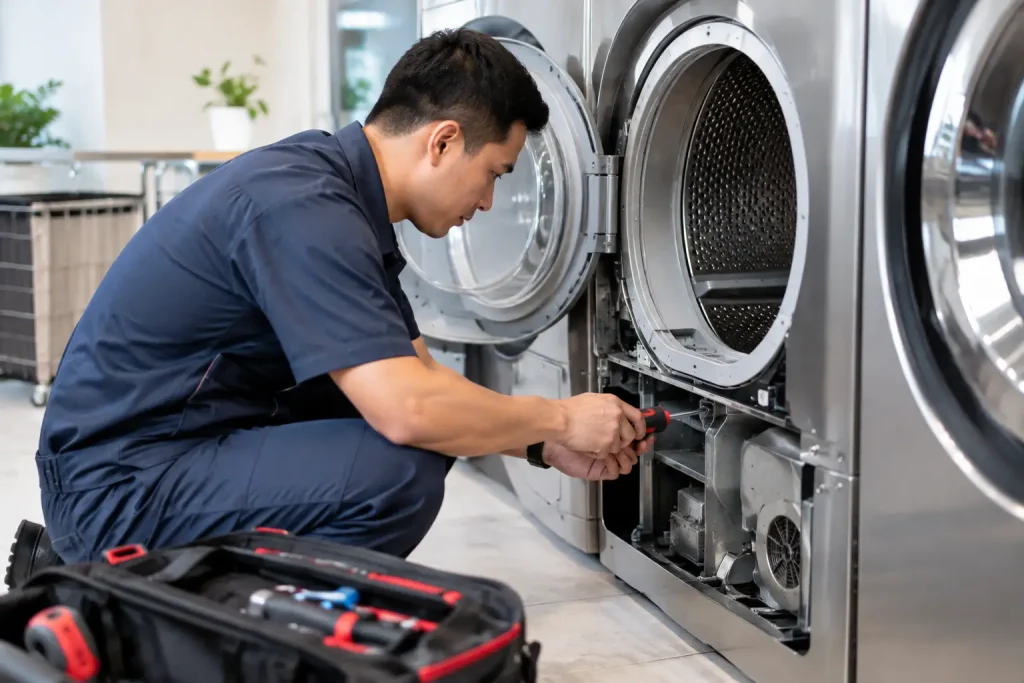
A commercial dryer that runs but leaves every load damp can quickly create a queue of frustrated customers, delayed linen turnover, and higher operating costs. Effective laundromat dryer repair starts with identifying whether the problem is heat, airflow, drum movement, controls, or the power supply. The symptoms may look similar from the outside, but the required repair can be very different.
For laundromats, hotels, cafés, salons, hostels, and other businesses in Singapore, a dryer is not a convenience. It is part of daily operations. Acting early can prevent a minor airflow restriction or worn component from turning into a complete breakdown.
Common Laundromat Dryer Repair Problems
Commercial dryers work harder than household models. They handle repeated cycles, heavier loads, more lint, and longer daily operating hours. This puts steady strain on heating parts, motors, belts, bearings, sensors, and exhaust systems.
The dryer is running but not heating
A spinning drum without heat is one of the most common service calls. On an electric commercial dryer, possible causes include a faulty heating element, failed thermostat, blown thermal fuse, damaged wiring, or an issue with the control board. If the dryer uses gas, the igniter, flame sensor, gas valve coils, or burner assembly may be at fault.
Do not assume the heating element is always the problem. A dryer may stop heating because airflow is restricted and its safety device has activated to prevent overheating. Replacing a thermal fuse without resolving the blocked vent can lead to the same fault returning.
Clothes take too long to dry
Long drying times usually point to poor airflow before they point to a failed heater. Check whether lint screens are cleaned after every cycle and whether the exhaust outlet has strong airflow while the dryer is operating. A clogged duct, crushed flexible vent, excessive bends, or a blocked external outlet can trap hot, humid air inside the machine.
Overloading also makes drying inefficient. When a drum is packed too tightly, clothes cannot tumble freely and air cannot circulate through the load. However, if drying times remain long with normal-sized loads and a clean lint filter, professional inspection is sensible.
The drum will not turn
If the display lights up and the machine starts but the drum remains still, stop the cycle and avoid repeatedly restarting it. A worn drive belt is a common cause, especially when the motor can be heard running. Other possibilities include a faulty motor, failed motor capacitor, damaged idler pulley, seized drum rollers, or a control issue.
Continuing to operate a dryer with a slipping belt or worn roller can create burning smells, abnormal noise, or additional motor strain. This is usually a repair worth addressing promptly because replacing a belt or roller is often less involved than replacing a motor assembly.
The dryer is noisy or vibrating
Thumping, squealing, scraping, or rumbling noises are not normal in a commercial dryer. Thumping can come from flat spots on drum rollers or bulky items being dried incorrectly. Squealing often suggests worn rollers, a tension pulley, or a belt. A scraping sound may indicate an object caught between the drum and housing, or worn drum glides.
Vibration can also be caused by an uneven machine, loose mounting hardware, or an unbalanced load. If the noise continues when the drum is empty, the problem is more likely mechanical and should be inspected before a component fails completely.
The dryer stops mid-cycle or shows an error code
Intermittent stopping can be frustrating because the dryer may work normally on the next load. Heat buildup, poor ventilation, a loose connection, a failing door switch, or an overheating motor can all cause this behavior. Error codes can be useful, but they are not always a final diagnosis. The same code may relate to a sensor fault, wiring issue, or control-board problem.
Record the error code, when it appears, and whether the dryer is hot, noisy, or overloaded at the time. This gives the technician a clearer starting point and can shorten diagnostic time.
Safe Checks Before Calling for Dryer Repair
A few simple checks can help identify obvious operating issues without dismantling the dryer. First, empty the lint filter and look for tears or lint bypassing the screen. Next, confirm that the dryer door closes firmly and that nothing is blocking the vent outlet.
For coin-operated or card-operated units, check whether the cycle has been properly selected and whether the payment system is registering the transaction. A machine that appears dead may have a payment, door-latch, or control setting issue rather than a major dryer failure.
If you notice a burning smell, smoke, sparks, repeated tripping, or excessive heat around the dryer, switch it off and stop using it. Do not remove electrical panels or attempt to bypass thermal fuses, door switches, or safety controls. These parts protect the machine and its users from overheating and other hazards.
What a Professional Laundromat Dryer Repair Visit Should Cover
A proper commercial dryer diagnosis should look beyond the part that appears to have failed. A technician may test heating performance, electrical supply, thermostats, sensors, motor operation, belt condition, roller wear, door switches, and control functions. They should also inspect airflow from the dryer through the exhaust path.
For gas dryers, burner ignition and combustion-related components require careful assessment. For stacked units, access can be more involved, and a fault in one section should not be assumed to affect the other without testing.
The best repair approach depends on the dryer model, age, usage level, availability of compatible spare parts, and overall machine condition. Genuine or suitable high-quality replacement parts generally provide better reliability than mismatched components, particularly for parts exposed to heat and constant movement.
Repair Cost Factors and When Replacement Makes Sense
There is no single price for commercial dryer repair because the cause of the fault matters more than the symptom. A clogged vent, worn belt, door switch, or drum roller typically involves a different level of labor and parts cost than a motor, control board, or major heating assembly.
Before approving a repair, ask for a clear explanation of the failed component, the recommended work, and whether related wear has been found. For example, if a belt has failed because rollers are seized, replacing only the belt may not be the best long-term decision.
Replacement may make more sense when a dryer has recurring major faults, obsolete parts, severe corrosion, or repair costs that are high relative to a comparable commercial unit. Still, age alone is not enough reason to replace a machine. A well-maintained commercial dryer with a replaceable mechanical fault can often return to reliable service after repair.
Preventive Maintenance That Reduces Downtime
The most useful maintenance is consistent, not complicated. Clean lint filters after every cycle, and do not allow lint to build up around filter housings or exhaust connections. Staff should report unusual noise, reduced heat, error codes, and longer drying times as soon as they appear.
Set a routine schedule for professional inspection of the vent path, belt, rollers, pulleys, heating system, and electrical connections. The right interval depends on daily load volume, machine type, and the length and layout of the exhaust duct. High-use laundromats may need more frequent attention than a small business with occasional laundry loads.
Avoid overloading machines and make sure the dryer is used for items it is designed to handle. Heavy items can be dried safely when the machine capacity and cycle settings are appropriate, but forcing oversized loads into the drum increases stress on moving parts and reduces drying performance.
For businesses that depend on reliable laundry operations, keeping a record of each dryer’s repairs, error codes, and service dates is practical. Patterns often reveal whether one unit has a developing issue or whether a shared venting system needs attention.
A dryer does not need to fail completely before it deserves service. Fast action on slow drying, noise, heat loss, or repeated stops helps protect your equipment, reduce customer disruption, and keep laundry moving when it matters most.