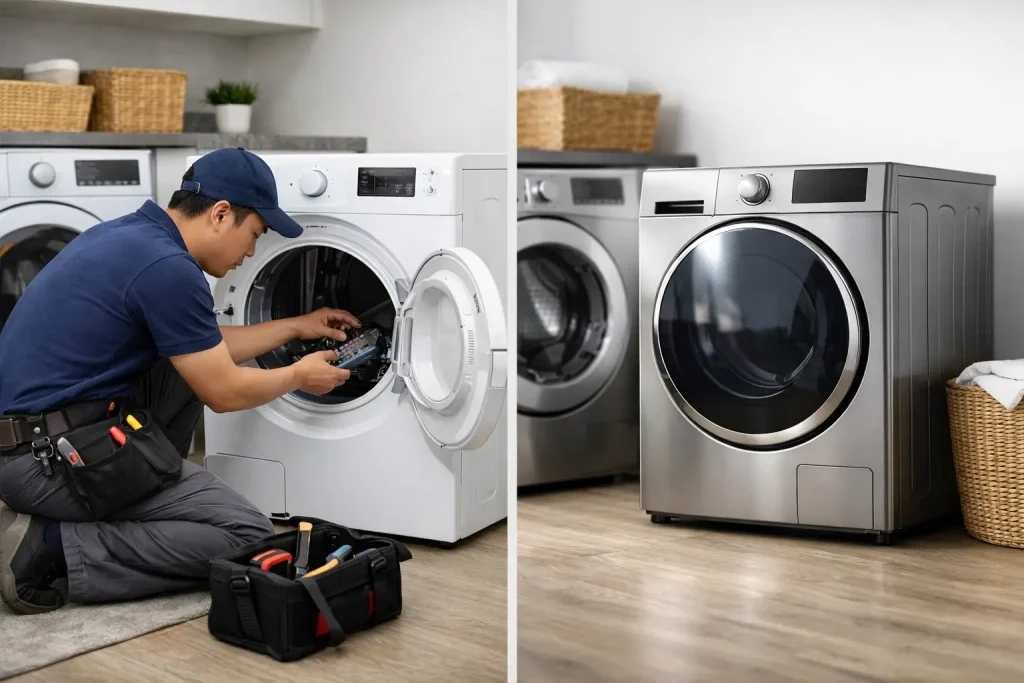
A dryer that suddenly stops heating can turn a normal laundry routine into a problem, especially in Singapore’s humid weather. The dryer repair vs replacement decision is not only about the price of a new appliance. The age of the dryer, the exact fault, safety concerns, availability of parts, and how often it is used all matter.
A professional diagnosis gives you the clearest answer. Some faults are relatively straightforward and worth repairing, while others point to an appliance that is nearing the end of its reliable working life. Here is how to make a practical decision before spending money on either option.
Start With the Dryer’s Age and Condition
Most household dryers can provide many years of service when they are used correctly and maintained regularly. However, age alone should not decide whether to replace one. A well-maintained dryer with one failed component may be a good repair candidate, even if it is no longer new.
As a general guide, repairing often makes sense when the dryer is under seven to eight years old, has not had repeated major faults, and is otherwise in good condition. This is particularly true when the drum turns smoothly, the control panel works properly, and there is no serious corrosion or damage to the cabinet.
Replacement becomes more reasonable when an older dryer has frequent breakdowns, requires multiple parts at once, or has already had expensive repairs in recent years. A machine that has needed a heater, motor, control board, or drum-related repair within a short period may continue to create disruption and added cost.
For landlords, property managers, and businesses, downtime matters as much as the repair bill. A shared laundry dryer or a commercial unit that repeatedly fails can affect tenants, staff, or daily operations. In these cases, reliability should carry more weight in the decision.
Dryer Repair vs Replacement: Compare the Real Cost
The lowest upfront price is not always the lowest overall cost. A new dryer involves the appliance price, delivery, installation, and possible removal or dismantling of the old unit. For built-in or stacked laundry setups, fitting a replacement model may also be less straightforward than expected.
On the other hand, a repair quote should be considered carefully when it is a large portion of the cost of a comparable new dryer. Many homeowners use a simple rule: if the repair is close to half the replacement cost and the appliance is already old or unreliable, replacement may be the better long-term choice.
That rule is useful, but it is not absolute. A high-quality dryer may be worth repairing when the problem is isolated and spare parts are available. Replacing a relatively new condenser dryer because of a single faulty sensor, for example, may create unnecessary expense.
Ask for a clear diagnosis that explains the failed part, labor required, expected repair cost, and whether there are signs of other worn components. Honest service means knowing when a repair will extend the dryer’s life and when it is only a short-term fix.
Faults That Are Often Worth Repairing
Many common dryer problems can be repaired without replacing the entire appliance. The right solution depends on the model and fault, but these issues are frequently repairable:
- A dryer that runs but does not heat may have a faulty heating element, thermostat, thermal fuse, sensor, or wiring connection.
- A dryer that will not start may have a damaged door switch, start switch, power connection issue, or control fault.
- A noisy dryer may need worn drum rollers, bearings, a belt, a tensioner, or another moving part replaced.
- A dryer that stops mid-cycle may have an overheating issue, airflow restriction, moisture sensor fault, or electronic control problem.
- A condenser or heat-pump dryer that leaves clothes damp may have a blocked filter area, pump issue, sensor problem, or fault in the drying system.
These faults should still be diagnosed properly. A dryer that is not heating, for example, may appear to need a new heating element, but poor airflow can cause an overheat protection device to trip. Replacing one part without identifying the cause can lead to the same fault returning.
When Replacement Is the Safer Choice
Some problems make replacement more sensible, particularly when safety or major structural damage is involved. If you notice burning smells, smoke, visible scorching, melted components, repeated tripping during use, or severe damage to the power cord, stop using the dryer immediately. Do not continue testing it while waiting to see if the problem clears.
Replacement may also be the better option if the drum is badly damaged, the motor has failed in an older unit, or the main electronic control board is both costly and difficult to source. Spare parts for discontinued models can be limited, and using unsuitable parts may affect performance and safety.
Corrosion is another concern in Singapore’s warm, humid environment. Light surface marks may not be serious, but extensive rust around the drum, door area, internal panels, or mounting points can indicate that the appliance is no longer a dependable long-term option.
For older vented dryers, a replacement can also offer better drying control and lower energy use. This does not mean every old dryer must be replaced. It means the expected savings, household laundry needs, and repair outlook should be considered together.
Consider the Type of Dryer You Own
The type of dryer affects both repair options and replacement costs. Vented dryers are usually simpler in design, but airflow must be managed correctly for safe and efficient drying. Condenser dryers collect moisture in a tank or drain system, while heat-pump dryers use a more energy-efficient drying method but have more specialized components.
A condenser dryer that takes too long to dry may only need its filters, condenser area, drainage path, or pump checked. Replacing it before investigating these areas can be premature. Similarly, heat-pump dryers can have sensor, fan, compressor, or airflow-related faults that require experienced troubleshooting rather than guesswork.
Before buying a replacement, confirm that it will suit your available space, electrical requirements, drainage arrangement where applicable, and stacking configuration. A dryer that looks suitable online may not fit safely into an existing laundry cabinet or match the current installation setup.
Look Beyond the Fault: Usage and Maintenance Matter
A dryer used by a large family, shared household, salon, hotel, or other business will experience more wear than a unit used once or twice a week. Heavy use does not automatically mean replacement, but it can shorten the working life of belts, bearings, motors, and heating components.
Poor maintenance can also make a repair look worse than it is. Lint buildup reduces airflow, increases drying times, and can contribute to overheating. Cleaning the lint filter after every load is one of the simplest ways to protect the appliance. Condenser and heat-pump models also need regular attention to their filters, water container, and accessible airflow areas according to the manufacturer’s instructions.
Avoid overloading the drum. Clothes need room to tumble so warm air can move through the load. Overloading can leave laundry damp, strain moving components, and cause users to run extra cycles, which increases wear and energy consumption.
Questions to Ask Before Approving a Repair
A repair decision should feel informed, not rushed. When a technician assesses your dryer, ask what caused the fault, whether the proposed repair addresses the root cause, and whether other worn parts are likely to fail soon.
It is also useful to ask whether genuine or compatible spare parts are being used, whether the part is available locally, and what testing will be done after the repair. A proper service should verify heating, drum movement, airflow, door operation, sensors, and cycle performance where relevant.
If replacement is recommended, ask why. The explanation should be specific: excessive repair cost, unavailable parts, repeated faults, safety concerns, or poor overall condition. “It is old” by itself is not enough information to make a confident choice.
Make the Decision With Confidence
Choose repair when the fault is isolated, the dryer is otherwise reliable, the cost is proportionate, and suitable parts are available. Choose replacement when the unit has major safety issues, recurring expensive faults, severe damage, or poor reliability that will likely continue.
For homeowners and businesses across Singapore, a professional diagnosis can prevent unnecessary replacement and avoid spending on repairs that will not last. Fix It Appliance can assess the fault clearly, explain the practical options, and help you decide what gives your laundry routine the most dependable path forward.