
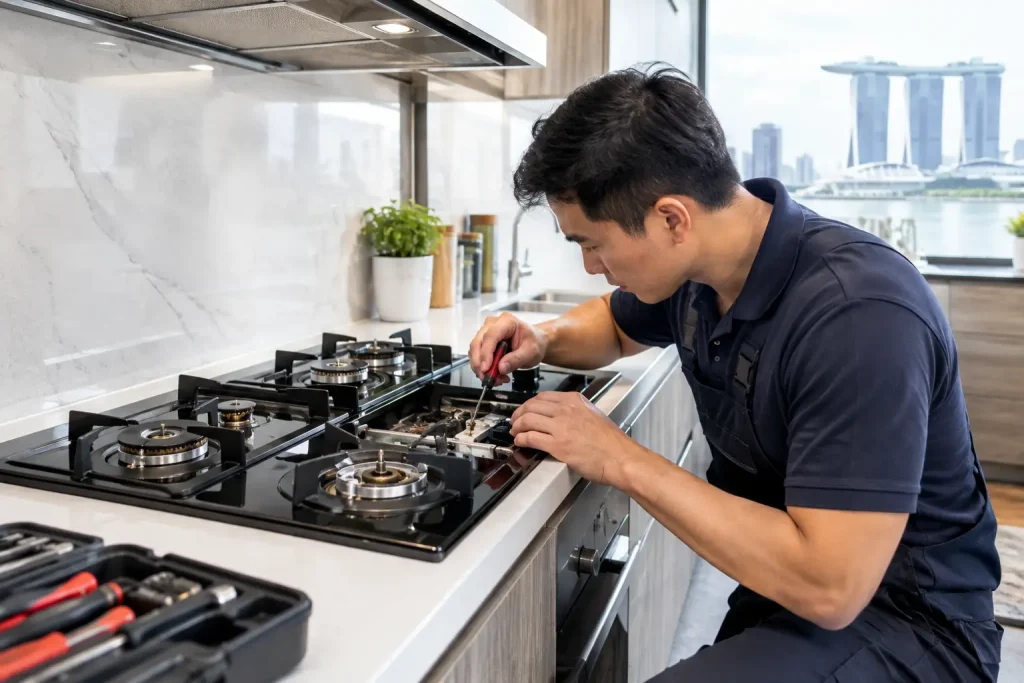
A hob that will not ignite, heat evenly, or respond to its controls can bring a kitchen routine to a stop. Hob repair is often more straightforward than homeowners expect, but the right next step depends on whether you have a gas hob, ceramic hob, or induction cooktop. Some faults are caused by simple surface contamination or incorrect cookware. Others involve heat-damaged parts, failed controls, or gas-related components that should only be handled by a qualified technician.
For homes, rental properties, cafés, and commercial kitchens in Singapore, acting early can prevent a small cooking fault from becoming a larger and more costly repair. The key is to recognize what is safe to check yourself and when to stop using the appliance.
Common Hob Problems and What They Usually Mean
Different hob types fail in different ways. Knowing the pattern helps narrow down the likely cause, although an accurate diagnosis may still require testing internal components.
Gas hob clicks but will not light
If you hear repeated clicking but there is no flame, first check that the gas supply is available and that the burner cap is sitting flat in its correct position. A burner cap that is even slightly misaligned can prevent the flame from forming properly. Food residue, grease, or moisture around the ignition electrode can also stop the spark from reaching the gas effectively.
After cleaning and fully drying the burner area, try again. If the igniter continues clicking after the flame has appeared, if only one burner is affected, or if there is no spark at all, the ignition electrode, ignition switch, wiring, or spark module may need repair or replacement.
Do not repeatedly attempt to light a burner if you can smell gas. Turn the burner control off, avoid creating sparks or flames, ventilate the area if safe to do so, and arrange professional assistance.
Gas flame is weak, yellow, or uneven
A healthy gas flame is generally steady and mostly blue. A weak or uneven flame is often caused by blocked burner ports or a dirty burner head. Spills that have dried inside the small openings can interfere with gas flow, especially on frequently used burners.
Remove the burner parts only when the hob is cool, then clean them gently according to the manufacturer’s instructions. Avoid using sharp tools that can enlarge or damage the ports. If the flame remains yellow, lifts away from the burner, or goes out unexpectedly, stop using that burner until it has been checked. The issue may involve the gas supply, burner assembly, or flame safety system.
Ceramic hob has a zone that will not heat
A ceramic hob may look simple on the outside, but it contains heating elements, temperature limiters, control switches, and wiring below the glass. When one zone does not heat while the others work, the likely causes include a failed heating element, damaged energy regulator, loose connection, or faulty control board.
A cracked ceramic surface is a separate safety concern. Do not continue cooking on a cracked glass top, even if the heating zone still works. Moisture and spills can reach internal components through the crack, creating a greater risk of damage.
Induction hob turns on but does not detect a pan
Induction cooktops need cookware with a magnetic base. If the pan-detection symbol appears or the unit switches itself off, test it with another induction-compatible pot or pan. The base should be flat, clean, and large enough for the cooking zone.
If suitable cookware is not detected, the fault may be in the pan sensor, induction coil, cooling fan, power module, or control board. Induction hobs also use high-voltage components. Internal diagnosis should be left to an experienced appliance technician.
Controls flash, beep, or stop responding
Touch controls can become unresponsive after a spill, steam exposure, or a buildup of grease on the panel. Wipe the surface with a soft, dry cloth and make sure no objects are resting on the controls. Some models lock the control panel, so check the user manual for the child-lock procedure.
When controls flash repeatedly, show an error code, or fail after power has been restored, the problem may be more than a temporary reset issue. A technician can identify whether the fault is related to the touch panel, wiring, power board, or another internal part.
Safe Checks Before Calling for Hob Repair
A few basic checks can save time, but they should never involve dismantling the hob, opening electrical connections, or altering gas components. Start by turning the hob off and allowing it to cool completely.
For a gas hob, confirm that the burner caps and crowns are clean, dry, and correctly positioned. Check for visible food debris around the ignition point. For ceramic and induction models, clean the glass surface and ensure the controls are dry. If your induction hob will not heat, test with a compatible pan before assuming the appliance has failed.
You can also check whether other parts of the appliance are working. For example, if all electric cooking zones and the display are dead, the issue may relate to the hob’s power supply or internal protection system. If one zone is dead but the others work normally, a single heating circuit or component is more likely involved.
Do not remove the glass top, attempt to reconnect loose wires, or bypass a safety feature. These repairs require access to components that can retain heat or electrical charge. Gas hob repairs also require careful testing to ensure the appliance operates safely after work is completed.
When You Should Stop Using the Hob Immediately
Some symptoms should not be monitored or worked around. Stop using the hob and arrange professional inspection if you notice a gas smell, a cracked glass surface, sparks, smoke, scorch marks, repeated tripping of the circuit breaker, or an electric shock sensation when touching the appliance.
Also stop using a gas burner if the flame goes out during use, burns abnormally, or cannot be controlled reliably. For induction and ceramic hobs, do not continue using a zone that overheats, cycles erratically, or displays an error message that returns after a basic reset.
Commercial kitchens should take these signs particularly seriously. An unreliable hob can disrupt service, but continued use can also damage cookware, affect food preparation, and lead to longer downtime if a minor component failure spreads to other parts of the appliance.
What a Professional Hob Repair Visit Involves
Proper hob repair begins with diagnosis, not guesswork. A technician will identify the hob type and model, check the reported fault, inspect visible components, and test the relevant heating, ignition, sensing, or control systems.
For gas hobs, this may involve checking burner assemblies, ignition electrodes, flame failure devices, switches, and gas-related connections. For ceramic hobs, testing may focus on heating elements, regulators, thermal limiters, and wiring. Induction hob diagnosis may include the cooling fan, coil, sensors, power module, and electronic control board.
Once the cause is confirmed, the technician can explain whether a replacement part is available and whether the repair is worthwhile. This matters because the same symptom can have very different repair requirements. A faulty ignition electrode is usually a targeted repair. A failed induction power module or damaged glass surface can be more expensive, particularly for older or premium built-in models.
Repair or Replace: How to Make the Right Call
Repair is often the sensible choice when the hob is relatively new, the fault is limited to one replaceable component, and the glass or main structure is in good condition. A quality built-in hob can last for many years with proper maintenance, and replacing a single faulty part may restore normal operation at a reasonable cost.
Replacement may be more practical when the hob has multiple recurring faults, a major part is unavailable, the glass is badly damaged, or the repair cost is close to the cost of a suitable replacement. Built-in dimensions also matter. Replacing a hob may require checking the cutout size, ventilation requirements, and compatibility with the existing installation.
For landlords and property managers, a clear diagnosis is especially useful. It helps distinguish between a one-time repair, a wear-related part replacement, and an appliance that is no longer economical to maintain.
Simple Maintenance That Helps Prevent Hob Faults
Most hob problems cannot be prevented entirely, but regular care reduces common issues. Wipe spills promptly once the surface has cooled. On gas hobs, keep burner caps, crowns, and ports free from grease and food residue. Do not flood the ignition area with water during cleaning.
For ceramic and induction hobs, use cookware with clean, flat bases to reduce scratches and improve heat transfer. Avoid dragging pots across the glass. Keep vents clear on induction models, and do not cover or block them while cooking.
If your hob begins showing early warning signs, such as intermittent ignition, slow heating, unusual beeping, or a burner that works only sometimes, arrange inspection before the problem becomes a complete failure. Reliable repairs start with an accurate diagnosis, and timely attention can help bring your appliance back to safe, dependable use.


