
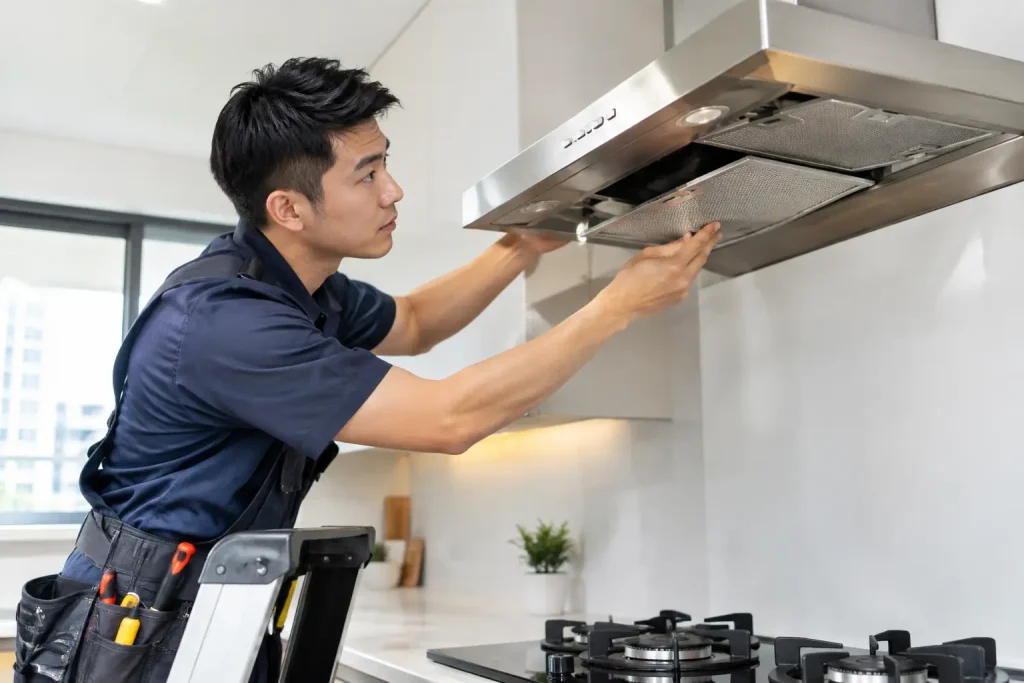
A cooker hood that sounds normal but leaves steam, smoke, and cooking odors hanging around is not doing its job. To fix cooker hood weak suction, start with the parts that restrict airflow most often: the grease filters, ducting, external vent, and fan. Many cases have a simple cause, but a persistent loss of extraction can also point to a motor, control, or installation fault.
Start by confirming the type of cooker hood
Before removing any parts, check whether your cooker hood is ducted outside or recirculating. A ducted hood pulls air through filters and sends it outdoors through a duct. A recirculating hood passes air through grease filters and charcoal filters, then releases the air back into the kitchen.
This difference matters. A recirculating model can reduce grease and some odors, but it will not remove heat or steam as effectively as a properly installed ducted hood. If your hood has always struggled with steam, especially during heavy cooking, its extraction type and installation may be the limitation rather than a sudden fault.
Also test every fan speed. If the highest setting is noticeably stronger than the lower settings, the motor is probably running, and airflow restriction is the most likely issue. If all speeds feel similarly weak or the motor sounds strained, further diagnosis may be needed.
Clean the grease filters first
Grease filters are the most common reason for weak cooker hood suction. Metal mesh or baffle filters collect airborne oil over time. Once clogged, they restrict air before it even reaches the fan.
Remove the filters according to the appliance manual. Most metal filters can be washed with warm water and a suitable degreasing solution. Let them dry fully before reinstalling them. Do not run the cooker hood without filters for regular use, as grease can build up inside the motor and fan housing.
For kitchens that see frequent frying or high-volume cooking, filters may need attention every few weeks. In Singapore’s warm, humid conditions, grease can remain sticky and build up quickly, particularly if the hood is used daily. A filter that looks only slightly dirty can still reduce airflow noticeably.
Do not wash charcoal filters
If your cooker hood is a recirculating model, it may have charcoal filters behind the metal grease filters. These are generally not washable or reusable. Their purpose is to absorb odors, and they lose effectiveness over time.
A saturated charcoal filter can make the hood seem weak because odors linger even when the fan is operating. Replace it with the correct filter type for your model. Depending on how often you cook, replacement is commonly needed every three to six months. Using an incorrect size or trying to clean a disposable carbon filter will not restore proper performance.
Check the duct and outside vent
For a ducted unit, clean filters alone may not fix cooker hood weak suction. Air must travel through the duct and exit through an external vent. Any blockage, crushed section, or poorly designed duct route reduces performance.
Look for obvious problems where accessible. Flexible ducting should not be compressed behind cabinets or bent sharply. Long duct runs, multiple tight turns, and undersized duct diameter all create resistance that the fan must overcome. A hood may be rated for strong airflow, yet perform poorly when connected to a narrow or restrictive duct.
Check the external vent cover as well. The flap should open freely while the hood is running. Grease buildup, debris, or a stuck backdraft damper can stop air from leaving the duct. If the flap does not move at all on the highest fan setting, switch off the hood and arrange for a professional inspection. The blockage may be inside the duct, or the damper may be jammed.
Avoid disconnecting concealed ductwork or reaching into inaccessible ceiling voids. Besides being difficult to reassemble correctly, loose ducts can release humid, greasy air into cabinets or enclosed spaces rather than directing it outside.
Listen for changes in the fan and motor
A healthy cooker hood produces a steady fan sound that increases with each speed setting. Rattling, scraping, humming without strong airflow, or a sudden change in noise can indicate an internal problem.
Grease can accumulate on the fan wheel, making it unbalanced or reducing the space between blades. In other cases, the motor bearings begin to wear, causing a louder hum or grinding sound. A damaged fan blade, loose mounting, or failing capacitor can also reduce the motor’s ability to reach the correct speed.
Switch off power at the appliance isolator before touching internal parts. Cooker hood motors and wiring are not suitable for casual DIY repair. A technician can safely inspect the fan assembly, test the motor and capacitor, and replace faulty parts where available.
When one speed no longer works
If the hood is weak only on one or two settings, the issue may be with the speed control, electronic board, switch, or capacitor rather than airflow blockage. For example, a fan that runs normally on high but barely turns on low may have a control fault. Conversely, a fan that never reaches high speed may have a failing capacitor or motor.
These faults can look similar from the outside, so diagnosis matters before ordering spare parts. Replacing a switch will not solve a worn motor, and replacing a motor is unnecessary if the problem is simply a clogged filter or faulty control module.
Check installation and make-up air
Sometimes the hood is working correctly, but the kitchen cannot supply enough replacement air. This can happen in tightly closed apartments when windows and doors are shut. Try running the hood on high with a nearby window opened slightly. If suction improves, the hood may be competing for air in an enclosed space.
This does not mean you should leave windows open all the time. It is simply a useful test. The correct long-term solution depends on the kitchen layout, hood type, and ventilation arrangement.
Installation height matters too. If a hood is mounted much higher than recommended above the cooktop, steam and smoke can spread before the hood captures them. A hood that is narrower than the cooking surface may also struggle to collect fumes from the front burners. These are performance limitations, not necessarily signs of a defective appliance.
What you can safely do and when to call for repair
Homeowners and tenants can usually clean metal filters, replace charcoal filters, check visible vent flaps, and confirm that ducting is not visibly crushed. These steps solve a large share of weak suction complaints.
Arrange professional cooker hood repair if you notice burning smells, repeated tripping, unusual vibration, no change between fan speeds, a fan that does not start reliably, or poor airflow after filters and accessible vents have been checked. Commercial kitchens should act quickly, as poor extraction allows grease and odors to build up faster and can affect day-to-day operations.
A technician can determine whether cleaning, duct correction, capacitor replacement, fan repair, or motor replacement is the sensible option. For older hoods with unavailable parts or a severely undersized installation, replacement may be more practical than repeated repair.
Keep suction strong after the repair
Run the cooker hood a few minutes before cooking and leave it on briefly afterward to clear remaining steam and odors. Clean metal filters regularly, replace charcoal filters on schedule, and avoid allowing grease to harden inside the hood.
If weak suction returns soon after cleaning, do not keep increasing the fan speed and hoping for better results. Early diagnosis protects the motor, keeps the kitchen more comfortable, and helps bring the cooker hood back to the level of extraction it was designed to provide.


