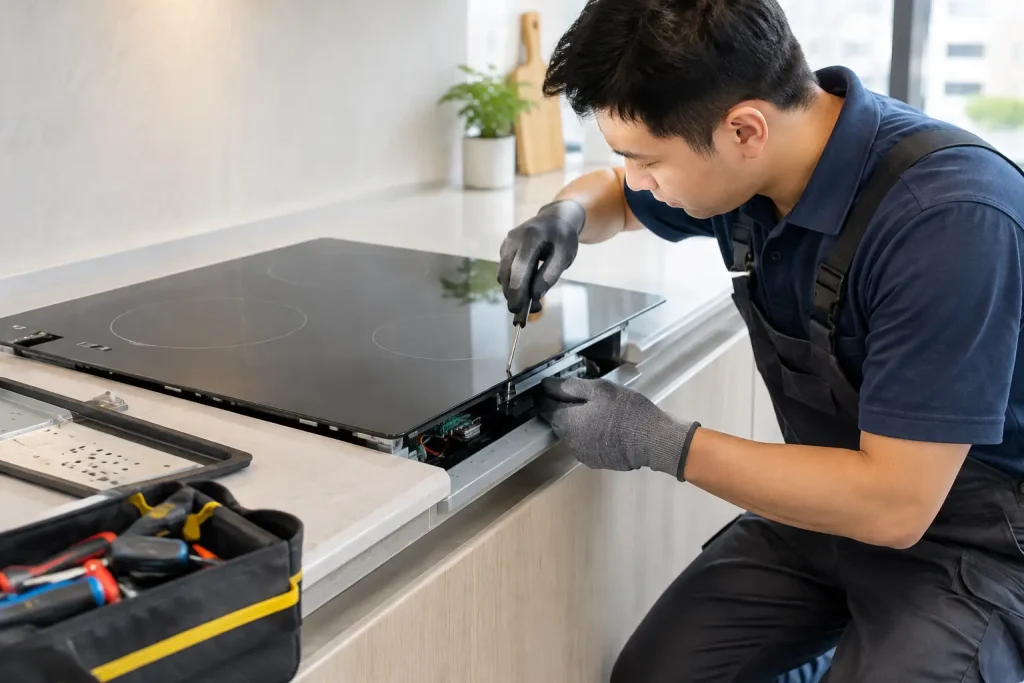
A cooktop that suddenly stops heating can disrupt every meal service at home or in a commercial kitchen. This induction cooktop repair review explains what common faults usually mean, what a professional diagnosis should cover, and when repair is a sensible choice for Singapore households and businesses.
Induction cooktops are efficient and responsive, but they are not simple appliances. Beneath the glass surface are electronic control boards, cooling fans, temperature sensors, power modules, and induction coils. A fault in one component can affect a single cooking zone or shut down the whole unit. The right decision is rarely based on the error code alone. It depends on the appliance’s age, condition, brand, built-in configuration, and the availability of suitable spare parts.
What a Proper Induction Cooktop Repair Review Should Check
A useful repair review begins with the symptoms, not assumptions. A technician should ask whether the cooktop has no power, trips the circuit, displays an error code, makes unusual noises, heats inconsistently, or fails to detect cookware. These details help narrow down the likely cause before any parts are ordered.
The next step is on-site testing. For a built-in induction hob, the technician may need to safely remove the unit from the countertop to inspect the underside, wiring connections, ventilation space, cooling fan, and internal boards. Heat damage, moisture marks, loose terminals, and burnt components can point to the real issue.
A good assessment also checks whether the fault is isolated. For example, one non-working zone may be caused by its coil, sensor, or power module. If every zone has stopped working, the main power supply, control board, or shared power module may be involved. This distinction matters because it affects both repair scope and cost.
Common Induction Cooktop Problems and What They Mean
The cooktop will not switch on
If the display is completely blank, first confirm that the appliance is receiving power and that the household circuit has not tripped. If the supply is normal, the internal power board, fuse, wiring, or control module may have failed. A cooktop that repeatedly trips the circuit should not be used until it has been inspected, as an internal short circuit or damaged component may be present.
One cooking zone does not heat
A single faulty zone is often repairable. The problem may be a damaged induction coil, temperature sensor, zone-specific power board, or connection issue. In some cases, the cooktop detects the pan but does not generate heat. In others, it may show an error code or switch off shortly after starting.
The cooktop does not detect cookware
Induction cooking requires compatible magnetic cookware with a flat base. Before arranging repair, test another suitable pot or pan on the affected zone. If compatible cookware is not detected across multiple zones, the fault may lie with the pan detection circuit, coil, or electronics.
Do not assume that a larger pan will always work better. A pan that is too small for the marked cooking zone, warped, or poorly centered may not be detected properly. If several known-compatible pans produce the same result, a professional diagnosis is worthwhile.
The cooktop shuts off during cooking
Induction units have safety systems that reduce power or shut down when internal temperatures are too high. Blocked ventilation, a failed cooling fan, excessive heat below the countertop, or a sensor fault can trigger this behavior. The glass surface may not feel excessively hot, but the internal electronics can still overheat.
This is particularly common with built-in cooktops installed in tight cabinetry. A repair technician should inspect the cooling fan and confirm that the required airflow around the appliance has not been restricted.
Clicking, buzzing, or fan noise
A low hum, clicking sound, or fan noise can be normal during operation. Induction technology transfers energy through a magnetic field, and certain cookware can vibrate slightly. However, loud buzzing, repeated clicking when no pan is present, grinding fan noise, or a burning smell requires attention.
A worn cooling fan may become noisy before it fails completely. Replacing it early can help prevent overheating damage to more costly electronic components.
Cracked glass or a damaged touch panel
A cracked glass surface is not only cosmetic. Spills can enter the appliance, and sharp or unstable cracks can worsen with heat. Whether glass replacement is practical depends on the model and spare-part availability. For older or lower-cost units, the cost of a replacement glass top can approach the value of a new appliance.
Touch controls that respond intermittently may be affected by moisture, grease buildup, a damaged touch panel, or a faulty control board. Avoid repeatedly pressing the panel or using the appliance if it activates functions by itself.
Repair Cost: What Affects the Final Price?
There is no single repair price for an induction cooktop because the appliance contains several high-value electronic parts. The main cost factors are the diagnostic work required, the brand and model, the number of affected zones, access to the built-in unit, and the price of replacement parts.
A straightforward fan, sensor, fuse, or wiring repair is usually less costly than replacing a power module or main control board. Glass top replacement and major board failures can be more expensive, especially when original parts are needed. Premium European models and discontinued models may have longer lead times or limited spare-part options.
The most reliable approach is to request a diagnosis before approving major work. An honest service assessment should explain the failed component, whether the part is available, the expected repair cost, and any concerns about the appliance’s remaining condition. This gives you a clear basis for deciding whether to proceed.
Repair or Replace? The Practical Decision
Repair is often worthwhile when the cooktop is relatively new, the glass is intact, the fault is limited to one component, and replacement parts are available. It can also make sense for a built-in unit that matches the existing countertop cutout, since replacing the appliance may create fitting issues.
Replacement deserves consideration when there are multiple major faults, extensive heat or water damage, a cracked glass surface combined with electronic failure, or unavailable parts. Age matters, but it should not be the only factor. A well-maintained older cooktop with one failed fan may be a better repair candidate than a newer unit with a damaged control board and signs of overheating.
For landlords, property managers, and commercial operators, downtime is another consideration. A clear repair estimate helps weigh the cost of restoration against the disruption of sourcing, fitting, and testing a replacement unit.
Safe Checks You Can Do Before Booking Repair
You can rule out a few simple causes without opening the appliance. Make sure the cooktop is unlocked, the controls are dry, and compatible cookware is centered on the correct zone. Check whether the circuit breaker has tripped and whether the appliance has an error code displayed. If the unit has been heavily used, allow it to cool and ensure that nearby ventilation openings are clear.
Do not remove the glass panel or attempt to test internal components yourself. Induction cooktops contain high-voltage parts that can retain an electrical charge even after power is switched off. Avoid using a cooktop with cracked glass, a burning smell, visible sparking, repeated tripping, or unexplained shutdowns.
Choosing an Induction Cooktop Repair Service in Singapore
Look for a repair provider that works on built-in induction cooktops and can diagnose electronic faults rather than simply recommending replacement. Clear communication is especially valuable: you should understand the suspected fault, the proposed repair, part availability, and the cost before work begins.
Fix It Appliance provides professional diagnostics and repair support for induction cooktops across Singapore. For homeowners and businesses, the goal is straightforward: identify the fault accurately, replace only what is needed, and bring the appliance back to safe, reliable operation where repair makes practical sense.
If your cooktop is heating unevenly, showing an error code, or shutting down without warning, stop relying on guesswork. A proper diagnosis can prevent a small fan, sensor, or connection issue from becoming a larger appliance failure.