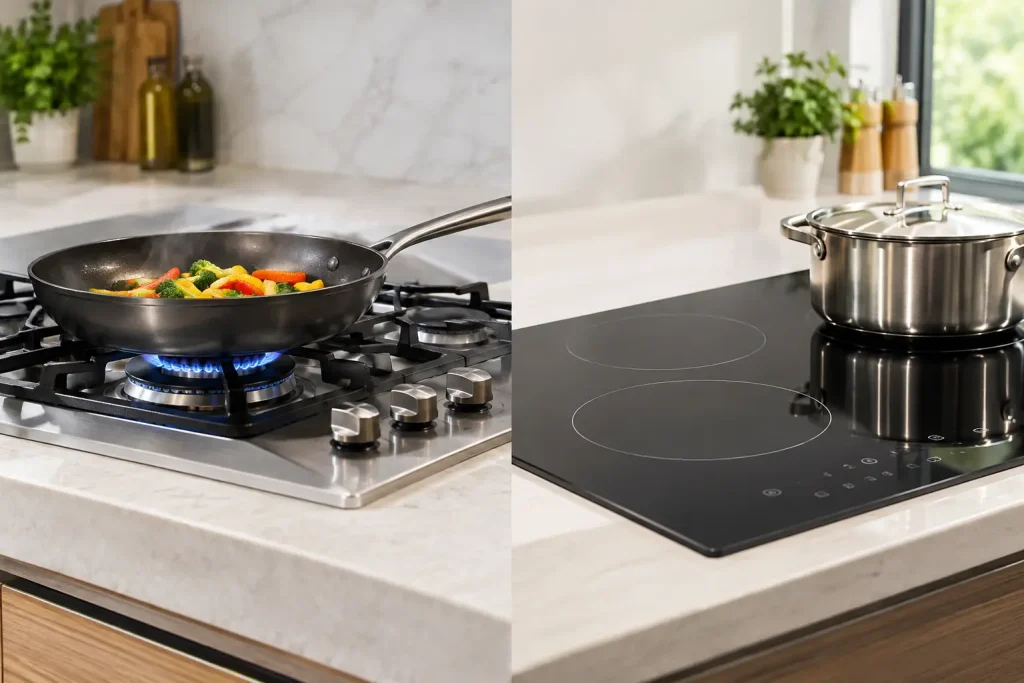
A cooktop decision becomes much more serious when the appliance stops igniting, heats unevenly, trips power, or displays an error code. For Singapore households and commercial kitchens, gas versus induction cooktops is not only about cooking preference. It affects daily safety, ventilation, cookware, maintenance, repair options, and the likely cause when something goes wrong.
Both types can be reliable for many years when correctly installed and maintained. The better choice depends on how the cooktop is used, the existing setup at the property, and whether the user is prepared for its specific care requirements.
Gas Versus Induction Cooktops at a Glance
A gas cooktop creates a visible flame from a gas supply. Heat is immediate, works with nearly any pan, and can be adjusted by looking directly at the flame. It has familiar mechanical parts, including burners, igniters, burner caps, valves, and gas supply components.
An induction cooktop uses electromagnetic energy to heat compatible cookware directly. The glass surface itself does not produce heat in the same way as a gas burner or ceramic hob. It typically heats pans quickly, offers precise low-heat control, and has a flat surface that is easier to wipe down.
The practical difference is this: gas cooktops rely on flame and gas components, while induction cooktops rely on electronics, sensors, cooling fans, and compatible cookware. Their faults, repair costs, and maintenance needs are therefore very different.
Heat Control and Everyday Use
Many users prefer gas because the flame provides immediate visual feedback. Turning the knob changes the flame at once, and the cooktop can accept stainless steel, aluminum, cast iron, and other common cookware. This can be useful in kitchens with a large existing collection of pots and pans.
Induction is often faster at bringing a pan to temperature because the pan receives the energy directly. Its control is responsive, although it can feel different from gas at first. Induction also performs well at lower settings, provided the cookware has a flat, magnetic base and good contact with the glass surface.
Not every pan works on induction. A simple check is to hold a magnet to the bottom of the cookware. If it sticks firmly, the pan will usually work. Aluminum, copper, and glass cookware normally require an induction-compatible magnetic base.
For busy homes, the faster heat-up time and easier cleanup of induction can be appealing. For users who want maximum cookware flexibility or prefer visible flame control, gas may be the better fit.
Safety Considerations in Singapore Homes
Induction cooktops have no open flame, and the surface around the cooking zone generally remains cooler than a gas burner. This can reduce the risk of accidental burns from the surrounding glass, although the area beneath a hot pan can still stay hot after use. Most models also have child locks, residual heat indicators, and automatic shutoff features.
Gas cooktops are safe when they are correctly installed, used carefully, and maintained. However, a yellow or uneven flame, repeated clicking, delayed ignition, or a gas smell should never be ignored. Turn off the appliance if safe to do so, avoid operating switches or creating sparks, ventilate the area, and arrange for professional assessment.
A gas flame should normally be stable and mostly blue. Orange or yellow tips can sometimes be caused by residue or moisture around the burner, but persistent flame color changes may indicate blocked burner ports, incorrect air mixture, or another fault that needs inspection.
Induction cooktops have their own safety concerns. Cracked glass, repeated circuit trips, a burning smell, fan noise that does not stop, or error codes should be checked promptly. Do not continue using an induction hob with a cracked surface. Moisture can enter the appliance and damage internal components.
Maintenance Requirements and Common Faults
Gas cooktops need regular cleaning around the burner caps, flame ports, and igniter points. Boil-overs and grease can block the ports or prevent the burner cap from sitting level. A burner may then click continuously, fail to ignite, light only on one side, or produce an uneven flame.
After cleaning, make sure burner caps are fully dry and positioned correctly. Many ignition complaints are caused by a cap that has been placed slightly off-center. Avoid pushing sharp objects into burner holes, as this can alter the flame pattern or damage components.
Common gas cooktop faults include weak ignition sparks, faulty ignition switches, damaged spark plugs, worn control valves, blocked burners, and failed flame-failure devices. These components can often be repaired or replaced if the cooktop body and burners are otherwise in good condition.
Induction cooktops need gentler surface care but more attention to the electronics. Use cookware with smooth, clean bases to reduce scratches. Wipe spills after the surface has cooled, especially sugary spills that may mark the glass. Do not place heavy items on the cooktop or slide rough-bottomed pans across it.
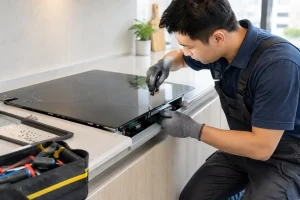
Typical induction faults include a cooking zone not detecting a pan, one zone heating poorly, touch controls not responding, cooling fan problems, error codes, power board faults, and damaged glass. A pan detection issue may be as simple as unsuitable cookware. If several zones fail at the same time, the cause is more likely to be internal electronics or the appliance power supply.
Repair Costs and When Repair Makes Sense
The cost of repair depends on the model, age, fault, and availability of spare parts. Gas cooktop repairs are often more straightforward when the problem involves burner caps, igniters, spark plugs, or switches. However, issues involving gas supply components should always be handled by qualified professionals rather than attempted as a DIY repair.
Induction repairs can range from a minor sensor or fan issue to a more costly control board or inverter board replacement. Built-in models may also take longer to access and test. If the glass is cracked, replacement may be worthwhile only if the correct glass assembly is available and the rest of the appliance is in good condition.
Repair is usually the sensible option when the cooktop is relatively new, the fault is isolated, spare parts are available, and the repair cost is reasonable compared with replacement. Replacement may be more practical when there are repeated electronic failures, serious corrosion, major glass damage, unavailable parts, or a repair estimate that is too close to the cost of a new unit.
For landlords and property managers, consider the appliance’s service history as well as the immediate repair. A cooktop that has needed multiple visits for unrelated faults may cause more disruption than a planned replacement.
Installation and Compatibility Before You Choose
Before changing from gas to induction, check more than the cutout size in the countertop. Induction cooktops may require a suitable dedicated power connection, correct ventilation clearance below the unit, and a circuit that matches the manufacturer’s specifications. A larger induction model can have higher power requirements than a small portable unit.
When replacing a gas cooktop with another gas model, confirm the appliance is compatible with the available gas type and that the burner layout fits the existing opening. The condition of the ignition system, gas hose or connection, and surrounding cabinetry should also be assessed during installation.
For either type, do not select a cooktop based on dimensions alone. Measure the existing cutout, confirm the required clearance, and check the model’s installation instructions. An appliance that physically fits may still perform poorly or overheat if it lacks the required ventilation space.
Which Cooktop Is Right for You?
Choose gas if you value a visible flame, want to use almost any cookware, and prefer repairs that are often mechanical and easier to diagnose. It is also a practical choice when the property already has a suitable gas setup and the cooktop is maintained regularly.
Choose induction if you want fast heating, a flat easy-clean surface, no open flame, and strong safety features. It is especially suitable for users willing to use compatible cookware and follow the appliance’s installation and ventilation requirements.
There is no universal winner. The most reliable cooktop is one that matches the property’s setup, is used correctly, and receives attention at the first sign of a fault. If your gas or induction cooktop is no longer performing as it should, a professional diagnosis can identify whether a targeted repair will bring the appliance back to reliable service.