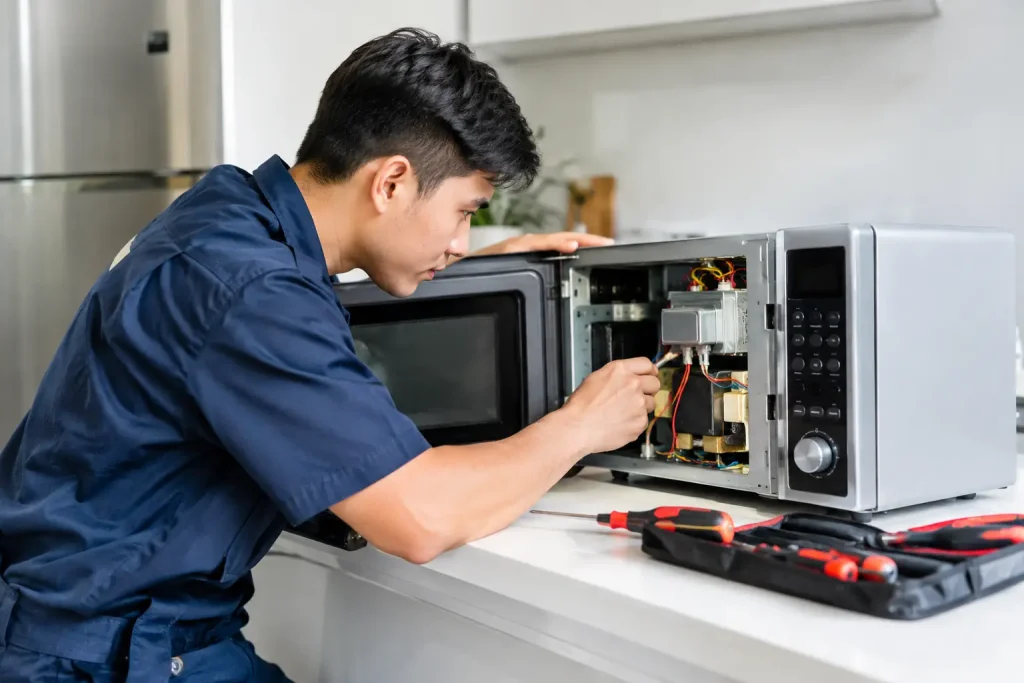
A microwave that still lights up and turns but leaves food cold is frustrating, especially when it is part of a busy household or commercial pantry routine. So, can microwave be repaired? In many cases, yes. A technician can often restore a microwave by replacing a failed part, correcting a door safety issue, or repairing a control fault. The sensible choice depends on the fault, the appliance’s age, its condition, and the cost of the required parts.
Microwaves are not a good appliance for trial-and-error repairs. Even after being unplugged, internal components can retain a dangerous electrical charge. A proper diagnosis helps identify whether a repair is practical without putting anyone at risk or spending money on the wrong solution.
Can a Microwave Be Repaired Safely?
Professional microwave repair is safe when it is carried out by a trained technician using the correct testing procedures. The technician will first confirm the symptoms, inspect the appliance, and test the relevant components. This matters because several different faults can produce the same result. For example, a microwave that does not heat may have a high-voltage component problem, but it may also have a faulty door switch or a control board issue.
Do not remove the outer casing to investigate a microwave yourself. The capacitor in a microwave’s high-voltage system can store electricity even when the power cord is disconnected. The risk is not worth taking, particularly when the fault may be simple to diagnose with the right equipment.
For countertop models, a repair is often straightforward if replacement parts are available and the cabinet, door, and interior cavity remain in good condition. Built-in microwave ovens may be even more worthwhile to repair because replacement can involve matching the cabinet opening, trim kit, ventilation requirements, and existing electrical connection.
Common Microwave Faults That Can Often Be Fixed
A microwave does not need to be completely dead before it requires attention. Changes in heating performance, unusual noises, and intermittent operation are all signs that a component may be failing.
The microwave runs but does not heat
This is one of the most common repair calls. The display may work, the turntable may rotate, and the interior lamp may come on, but food remains cold. Possible causes include a failed magnetron, high-voltage diode, capacitor, transformer, or inverter assembly, depending on the model.
These parts require careful testing. A magnetron replacement can be worthwhile on a quality built-in or premium microwave that is otherwise in good condition. On an older basic countertop unit, the repair cost may be close to a replacement unit, making replacement the more practical option.
The microwave sparks inside
Sparking can be alarming, but it does not always mean the microwave is beyond repair. A damaged waveguide cover, food debris, a chipped interior coating, or metal accidentally left inside can cause arcing. Stop using the appliance immediately if sparking occurs.
If the waveguide cover is burnt or damaged, it may be replaceable. However, severe burn marks, holes, or damage to the cavity walls can make repair uneconomical or unsafe. Continued use can damage the magnetron and other internal parts.
The microwave stops when the door moves
A microwave door has several safety interlock switches. These switches prevent the microwave from operating when the door is open. If a switch, latch, or door alignment mechanism wears out, the microwave may not start, may stop mid-cycle, or may trip the power supply.
Door switch and latch faults are frequently repairable. Prompt repair is advisable because forcing the door closed or repeatedly slamming it can worsen the problem.
The turntable does not rotate
A non-rotating turntable is usually caused by a worn turntable motor, coupler, roller ring, or incorrectly positioned glass tray. This is often a more affordable repair, particularly when the microwave still heats normally.
Some microwaves are designed to operate without turntable rotation, but most conventional units rely on it to heat food evenly. If one area is hot while another remains cold, do not assume the magnetron has failed before checking the turntable components.
The display, buttons, or clock are not working
Unresponsive buttons, a flickering display, random beeping, or a microwave that starts by itself can point to a faulty touchpad, membrane switch, control board, or moisture-related damage. A technician can determine whether the problem is limited to the control panel or whether the main board has failed.
Control board repairs depend heavily on part availability. For some models, a replacement board is readily available. For older or discontinued units, the board may be difficult to source, which can change the repair-versus-replace decision.
The microwave is unusually noisy
A loud hum, buzzing, rattling, or grinding sound should not be ignored. Rattling may come from the roller ring or turntable motor, while a louder electrical hum during heating can indicate a problem in the high-voltage system. A cooling fan fault can also cause noise and may lead to overheating if left unresolved.
When Is Microwave Repair Worth the Cost?
There is no single rule because microwave models vary greatly in price and construction. A repair is generally worth considering when the appliance is relatively new, the fault is isolated, spare parts are available, and the repair cost is clearly lower than purchasing and installing an equivalent replacement.
Built-in microwaves, combination microwave ovens, and commercial units usually deserve a proper diagnosis before replacement. Their replacement cost is higher, and installation may require more work than simply buying a new appliance. The same applies to models integrated with kitchen cabinetry or business equipment.
Replacement may be the better decision if the microwave has major cavity rust, repeated high-voltage failures, a damaged door structure, unavailable parts, or multiple faults. An older appliance that has already needed several repairs may not provide reliable service after another major component replacement.
For landlords, property managers, and business owners, downtime also matters. A quick repair may be preferable when a compatible replacement cannot be obtained immediately. On the other hand, a replacement may reduce future disruption if the current unit has become unreliable.
What a Professional Microwave Diagnosis Should Include
A useful service visit should do more than confirm that the microwave is faulty. The technician should check the power supply connection, door operation, control functions, heating performance, turntable movement, fan operation, and visible condition of the cavity and waveguide area.
After identifying the likely fault, the technician should explain the repair option in clear terms: which part has failed, whether it can be replaced, the expected cost, and whether replacement would be more sensible. This gives you the information needed to decide without guesswork.
When arranging service, provide the microwave’s brand, model number, approximate age, and symptoms. Mention whether it is a countertop, built-in, or commercial unit. Details such as “it hums but does not heat” or “it sparks near the side panel” help the technician prepare for the visit and check likely parts availability.
Steps to Take Before Booking Microwave Repair
First, stop using the microwave if there is sparking, smoke, a burning smell, visible damage, or repeated power trips. Unplug it if it is safe to do so. Do not continue testing it with different settings.
For minor issues, check that the power plug is secure, the door closes properly, the glass tray is seated correctly, and no metal object or foil has been left inside. If the appliance has a visible removable waveguide cover that is stained or damaged, avoid touching internal areas and arrange an inspection instead.
Keep the receipt or note the model number if available. If the microwave is still under a manufacturer warranty, check the warranty terms before arranging an independent repair. For appliances outside warranty, a diagnostic visit provides the clearest answer on repair feasibility.
How to Help Your Microwave Last Longer
Most microwave problems cannot be prevented completely, but a few habits reduce avoidable damage. Wipe food splatters promptly so grease and moisture do not build up around the cavity and waveguide cover. Use microwave-safe containers, avoid running the microwave empty, and do not force the door if it is not closing smoothly.
Make sure the ventilation openings are not blocked, especially for built-in units. Poor airflow can cause overheating and shorten the life of electronic components. If heating becomes uneven, noises change, or the door needs extra force to latch, arrange a check early rather than waiting for complete failure.
A microwave is often repairable, but the right decision comes from the condition of the appliance and a clear diagnosis, not from the symptom alone. Fix It Appliance can assess microwave faults across Singapore and advise honestly on whether a reliable repair or replacement is the better next step.