
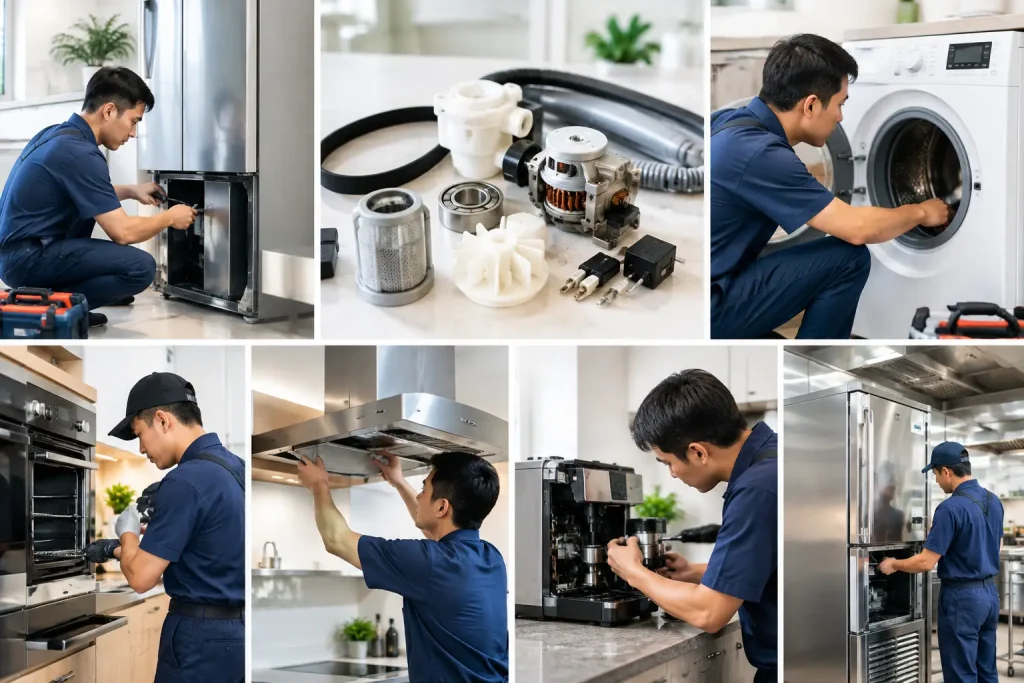
A refrigerator that is no longer cold, a washer that will not drain, or an oven that heats unevenly does not always need to be replaced. In many cases, the right Singapore appliance spare parts can restore normal operation at a sensible cost. The difficulty is identifying the actual fault before ordering a part that may not match the appliance or solve the problem.
A replacement part is only useful when it is compatible, correctly installed, and connected to a confirmed diagnosis. This matters especially in Singapore, where many homes and businesses rely on built-in appliances, compact laundry systems, wine chillers, and kitchen equipment that may use model-specific components.
Why the Correct Part Matters
Two appliances can look nearly identical yet use different door switches, control boards, heating elements, pumps, sensors, or fan motors. Manufacturers often revise parts during a product’s production run. A component from the same brand may physically fit but have a different connector, voltage rating, software version, or mounting arrangement.
Using the wrong part can create more work and expense. A refrigerator fan motor that runs at the wrong speed can affect cooling performance. An incorrect washing machine drain pump may leak or fail to connect properly. A non-matching oven heating element may trip the appliance or fail to heat evenly.
For this reason, the appliance model number matters more than the brand name alone. It is usually found on a rating label inside the refrigerator compartment, around the washing machine door frame, behind a dishwasher door, on the side of an oven cavity, or at the back of the appliance. If a serial number is available, it can also help confirm production details when parts have changed over time.
Finding Singapore Appliance Spare Parts That Match
Before buying a replacement, record the appliance brand, full model number, serial number where available, and the fault you are experiencing. A clear photo of the existing part, including its labels and connectors, can be useful, but it should not replace model verification.
The following details help prevent a costly mismatch:
- The full appliance model number, not only the product series
- The part number printed on the removed component, if visible
- Connector type, mounting points, dimensions, and voltage details
- The appliance’s age and whether it has had previous repairs
- The exact symptom, such as no cooling, water leakage, poor heating, or error codes
Symptoms are as important as part numbers. For example, a dryer that does not heat may have a failed heating element, but it could also have a faulty thermal fuse, thermostat, wiring issue, control board fault, or blocked airflow. Replacing the heating element without testing the rest of the circuit may result in another breakdown shortly afterward.
Genuine, OEM, and Compatible Parts
Genuine parts are supplied under the appliance manufacturer’s brand. They are typically the safest choice for critical electronic modules, sealed-system components, specialized sensors, and built-in appliance parts. Availability and price can vary, particularly for older models.
OEM parts are made by the original manufacturer of the component and may be supplied under a different label. In some situations, an OEM component is equivalent to the original installed part. A compatible aftermarket part is made by another manufacturer to suit specific models. It can be a practical option for common items such as filters, door seals, belts, rollers, or selected pumps, provided compatibility and quality have been checked.
The best choice depends on the part. Saving a small amount on a basic drain hose may be reasonable. Taking the same approach with a refrigerator control board, induction cooktop module, or gas hob ignition component can lead to repeat faults or safety concerns. A professional assessment can clarify whether a lower-cost compatible part is appropriate or whether the original specification should be maintained.
Common Appliance Parts That Fail
Wear-and-tear components are often responsible for everyday appliance problems. Washing machines commonly need drain pumps, inlet valves, door locks, belts, shock absorbers, or bearings. Dryers may require belts, rollers, idler pulleys, heating elements, thermostats, or door switches.
Refrigerators and freezers can develop faults in evaporator fan motors, defrost heaters, thermistors, door gaskets, start relays, water valves, or ice maker assemblies. A wine chiller may have a failed fan, sensor, compressor relay, or control board. Cooling problems, however, can also involve refrigerant-system faults that should only be handled by qualified technicians.
For ovens, microwaves, dishwashers, and cooktops, common replacement items include heating elements, temperature sensors, circulation pumps, drain pumps, door latches, ignition switches, capacitors, and touch-control assemblies. Built-in appliances deserve extra care because dismantling them incorrectly can damage cabinetry, connections, or ventilation arrangements.
A failed part is not always the root cause. A dishwasher pump may burn out because of debris or a blocked filter. A refrigerator fan can fail after ice builds up from a defrost issue. Replacing only the damaged component without addressing the cause may shorten the life of the new part.
When DIY Replacement Is Reasonable
Some straightforward tasks can be suitable for confident owners when the appliance is unplugged, isolated from water or gas supplies as needed, and the correct instructions are followed. Replacing a refrigerator shelf, water filter, simple door gasket, washing machine inlet hose, or dryer lint filter housing is often manageable.
Other jobs should be left to a trained appliance technician. These include work involving live electrical circuits, high-voltage microwave components, gas hobs, sealed refrigeration systems, induction cooktops, control boards, and internal wiring. A microwave can retain dangerous electrical charge even after it has been unplugged. Gas appliances also require proper leak testing after repair or reassembly.
There is also a practical issue: incorrect installation can damage a new part or create a separate fault. If an appliance shows burning smells, repeated tripping, sparks, water near electrical components, a gas smell, or severe overheating, stop using it and arrange professional diagnosis.
Repair Cost Versus Replacement Value
A spare part decision should consider more than the price of the component. Labor, access requirements, diagnostic time, the appliance’s age, and the likelihood of other worn parts all affect the final value of a repair.
Repair is often worthwhile when the appliance is otherwise in good condition and the fault involves a serviceable part such as a pump, valve, belt, gasket, motor, heater, sensor, or door lock. It can be particularly sensible for built-in ovens, dishwashers, wine chillers, and commercial equipment, where replacing the entire unit may involve removal, installation, and compatibility concerns.
Replacement may make more sense when a major component has failed on an older appliance with several existing issues, or when the required part is discontinued. A professional diagnosis helps separate a one-part repair from a sign that the appliance is nearing the end of its useful service life.
What Businesses Should Consider
For offices, cafés, hotels, and other commercial settings, appliance downtime affects daily operations. Keeping a record of model numbers, installation dates, past faults, and parts replaced makes future servicing faster. For essential appliances such as freezers, ice makers, coffee machines, and refrigerators, preventive maintenance can reduce emergency failures.
It is also useful to avoid storing unverified spare parts simply because they look similar. Parts stored for years may not suit newer equipment, and electronic boards can be damaged by moisture or improper handling. A technician can advise which frequently used consumables or wear parts are worth keeping available for your equipment.
Get the Diagnosis Before Ordering
The fastest repair is not always the one where a part is ordered first. It is the one where the fault is accurately identified, the correct component is sourced, and the repair is tested properly afterward. This reduces repeat visits, avoids wasted spending, and protects the appliance from further damage.
Fix It Appliance provides appliance diagnostics and spare parts replacement for household and commercial appliances across Singapore. If you have the model number and a clear description of the problem, a technician can assess whether a replacement part is available and whether repair is the sensible next step.
A correct part, fitted properly and backed by a careful diagnosis, can give a dependable appliance many more years of service.


