A chest freezer that feels cold is not necessarily cold enough. In Singapore’s warm, humid climate, a freezer can lose temperature gradually after a door seal problem, poor airflow, or a failing part. This chest freezer temperature guide explains the right setting, how to check the actual temperature, and when a fault needs professional attention.
What Temperature Should a Chest Freezer Be?
Set a chest freezer to -18°C (0°F). This is the standard target for long-term frozen storage and the temperature most manufacturers design their units to maintain.
Some models use a numbered dial rather than a digital display. On these freezers, a higher number usually means colder, but the exact result varies by brand and model. A dial set to “3” may be correct in one freezer and too warm in another. Do not rely on the number alone. The actual internal temperature is what matters.
For Singapore homes, offices, and commercial premises, it can be sensible to set the freezer slightly colder during very hot periods or when the lid is opened frequently. A range of about -18°C to -20°C (0°F to -4°F) is generally suitable. Going much colder than necessary can increase electricity use and may lead to excess frost buildup in manual-defrost units.
How to Check the Actual Freezer Temperature
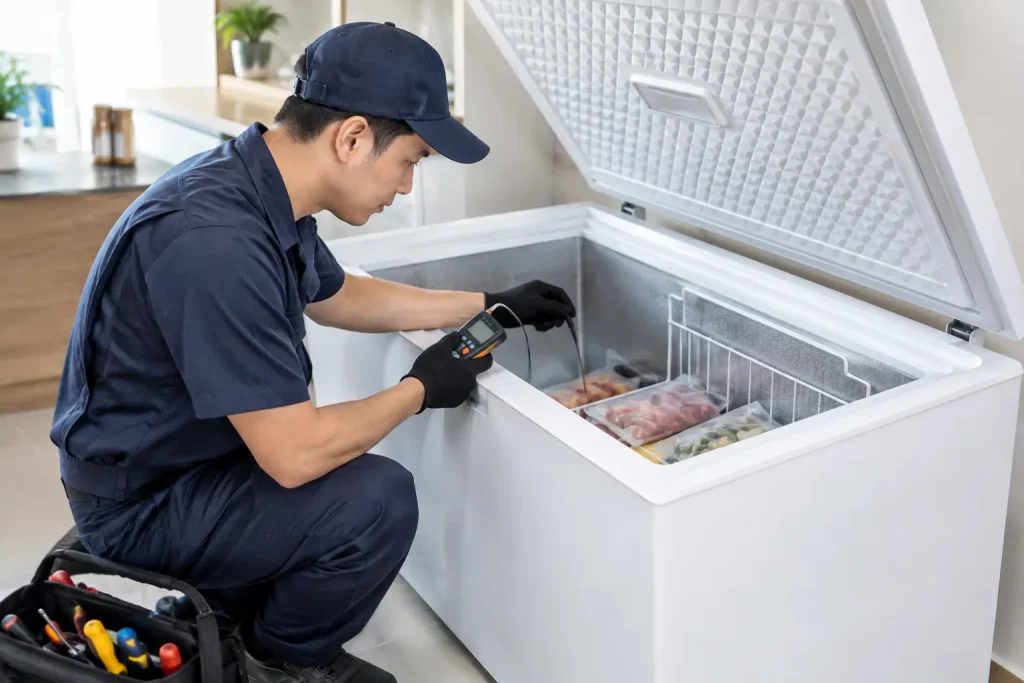
The most reliable method is a standalone freezer thermometer. Place it in the middle of the chest freezer, ideally between stored items rather than against the wall or directly near the base. Leave it in place for several hours, or overnight, before checking the reading.
A built-in display is useful, but it may show the temperature at one sensor location rather than the average temperature throughout the cabinet. If food near the top feels soft while the display says -18°C, use a separate thermometer to confirm the condition inside the freezer.
Check the temperature after the lid has remained closed for a few hours. Testing immediately after loading groceries, defrosting, or repeated opening will not give a stable reading. Chest freezers usually hold cold air better than upright freezers because cold air stays low when the lid is lifted, but frequent access still affects performance.
Why a Chest Freezer May Not Reach -18°C
A freezer that stays around -10°C or -12°C may still freeze items, but it is not operating at its intended storage temperature. The cause is sometimes simple, such as an incorrect setting or an overloaded basket. In other cases, it points to a developing mechanical fault.
The Lid Seal Is Leaking
A worn, split, dirty, or loose gasket allows warm humid air into the freezer. This makes the compressor work harder and creates frost around the lid edge. Run your hand around the closed lid to check for obvious cold air leakage. You can also close the lid on a sheet of paper. If the paper slides out easily at several points, the gasket may not be sealing properly.
Wipe the gasket and lid contact surface with a soft damp cloth, then dry them fully. If the seal is damaged, replacement is usually more effective than trying to reshape it.
Frost Buildup Is Restricting Cooling
A thin layer of frost is common in many chest freezers, especially manual-defrost models. Heavy ice buildup is different. Frost can cover internal surfaces, reduce usable storage space, interfere with lid closure, and reduce cooling efficiency.
If frost is more than about 1/4 inch thick, plan a manual defrost. Turn the appliance off, move contents to another cold storage option, and allow the ice to melt naturally. Do not chip ice with knives, screwdrivers, or sharp tools. Puncturing an internal wall can damage refrigerant lines and turn a manageable maintenance issue into a major repair.
Poor Airflow Around the Freezer
A chest freezer needs space around its exterior for heat to escape. If it is pushed tightly against a wall, boxed into a storage corner, or surrounded by cartons, the compressor may run longer and still struggle to hold temperature.
Check the manufacturer’s clearance recommendation where available. As a practical rule, leave open space around the sides and back, keep the ventilation areas free of dust, and avoid placing the freezer beside heat-producing appliances or in direct sun.
The Freezer Is Overloaded or Poorly Organized
A well-stocked chest freezer generally holds temperature better than an almost empty one. Frozen items help retain cold when the lid opens. However, packing the freezer so tightly that air cannot circulate can create uneven temperatures.
Use baskets or labeled containers to keep frequently used items near the top. Avoid placing large quantities of unfrozen items in the freezer at once. If you need to load a large amount, divide it into smaller batches where possible and keep the lid closed afterward so the unit can recover.
A Component May Be Failing
If the thermostat, temperature sensor, start relay, compressor, fan, defrost system, or sealed cooling system develops a fault, adjusting the control dial will not solve the problem. Warning signs include a compressor that runs continuously, clicking noises followed by silence, unusual heat around the exterior, thawing items, or a temperature that keeps rising despite the freezer being powered on.
These problems require proper diagnosis. Replacing parts based on guesswork can be costly, particularly when the actual issue is a sealed-system fault rather than a simple thermostat or relay problem.
Chest Freezer Temperature Guide: Settings and Everyday Use
The ideal setting depends on how the appliance is used. For normal household storage, maintain -18°C. For a chest freezer used in a business setting with frequent stock movement, check the temperature more regularly because repeated opening and larger loads create more demand on the system.
After a power interruption, keep the lid closed as much as possible. A full chest freezer can retain cold for longer than a partly filled one, but the exact duration depends on room temperature, insulation, and how often the lid is opened. Once power returns, check the thermometer rather than assuming the freezer has recovered immediately.
If the freezer has just been installed, moved, or transported on its side, follow the manufacturer’s waiting guidance before switching it on. Starting a compressor too soon after improper transport can cause operating problems. Once running, allow several hours for the cabinet to reach its target temperature before loading it fully.
When Temperature Problems Need Freezer Repair
Call for freezer repair if the unit cannot maintain -18°C after you have checked the setting, lid seal, ventilation space, and frost level. Prompt diagnosis is especially worthwhile when the freezer is relatively new, has a good capacity, or serves a business operation where stored stock matters.
A technician can test the thermostat or electronic controls, inspect the compressor starting components, assess the cooling system, and identify whether repair is sensible. For older units with compressor or refrigerant-system problems, repair versus replacement depends on the appliance age, condition, energy use, model availability, and cost of parts.
Fix It Appliance provides chest freezer diagnosis and repair across Singapore for households and businesses. A clear fault assessment helps you avoid replacing a freezer over a minor part issue, while also helping you decide when continued repair is no longer practical.
Simple Habits That Help Maintain Temperature
Keep the lid closed whenever possible and avoid leaving it open while deciding what to take out. Clean the lid gasket regularly, defrost before ice becomes excessive, and keep the freezer away from heat and blocked ventilation. A small freezer thermometer is also one of the most useful low-cost tools for spotting a temperature problem early.
If your chest freezer is consistently holding -18°C, closing securely, and running in normal cycles, it is doing its job. If the reading drifts upward or frost returns unusually fast, address it early before a small cooling problem becomes a complete freezer failure.