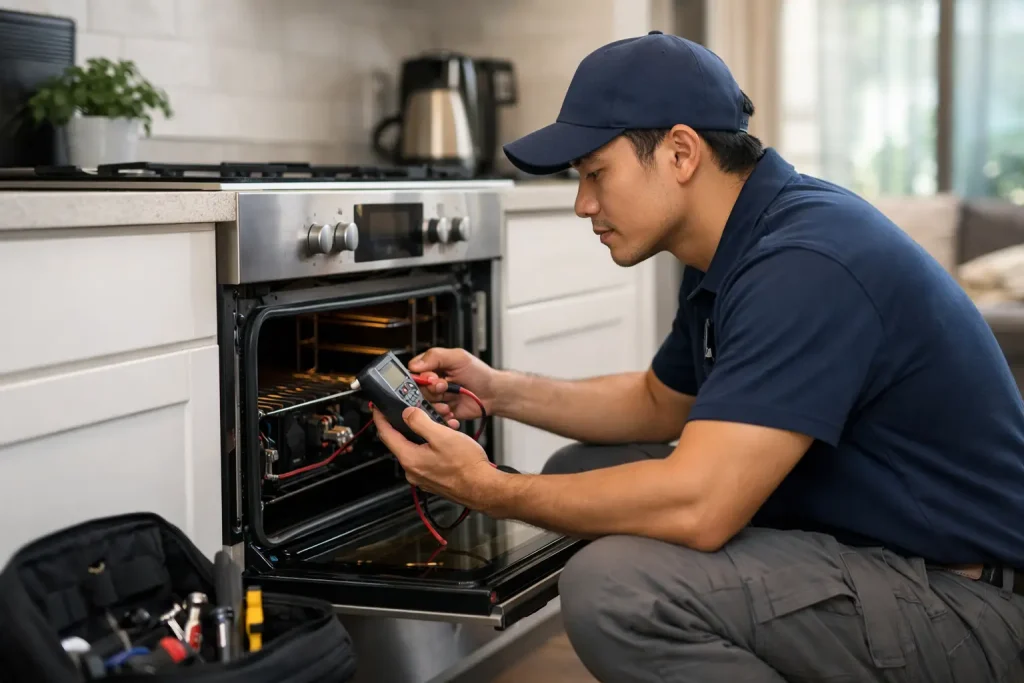
A faulty oven can disrupt a household, café, or commercial kitchen quickly. It may heat unevenly, fail to reach the selected temperature, trip the power supply, display an error code, or stop turning on altogether. When you are searching for how to choose an oven technician, the right decision is not simply about finding the lowest call-out price. You need someone who can diagnose the actual fault, explain the repair clearly, and carry out safe work on an appliance that produces high heat.
Start With the Type of Oven You Have
An oven technician should be familiar with the appliance in front of them, not just general household repairs. Before calling for service, check whether your unit is a built-in oven, freestanding cooker, microwave oven with a convection function, steam oven, or commercial oven. Note the brand, model number, approximate age, and the symptoms you have seen.
Built-in ovens often require more careful access because they are fitted into cabinetry. A technician may need to remove the unit safely to inspect wiring, heating elements, cooling fans, thermostats, control boards, or door components. Commercial ovens may have heavier usage, more complex controls, and greater downtime concerns. The technician should be able to discuss the repair approach for your specific oven type.
It also helps to state whether the oven is electric or gas-powered. These appliances have different fault patterns and safety requirements. Do not attempt to dismantle the oven yourself before the visit, especially if there is a burning smell, damaged wiring, a gas odor, or repeated power trips.
Look for Relevant Oven Repair Experience
Many appliance faults can appear similar at first. An oven that does not heat may have a failed heating element, but it could also have a faulty temperature sensor, thermal fuse, selector switch, relay, wiring connection, or control board. Replacing parts without proper diagnosis can waste time and money.
Ask whether the technician regularly repairs ovens and built-in ovens, rather than only handling general appliance service. Relevant experience matters when dealing with common issues such as:
- An oven that heats too slowly or not at all
- Food that cooks unevenly despite correct settings
- A fan oven that runs but blows cold air
- A door that does not close, seal, or latch properly
- Error codes, flashing displays, or unresponsive touch controls
- An oven that trips the circuit when heating starts
A capable technician does not need to promise a repair before inspection. In fact, a careful explanation that the fault must be tested first is usually a better sign than an instant diagnosis over the phone. They should be able to tell you what they will check and why.
Ask About Brand and Parts Knowledge
Oven components are not always interchangeable. Heating elements, thermostats, door hinges, fan motors, control boards, and glass panels vary by model. A technician should know how to identify the correct spare part using the model details, rather than fitting a part that merely looks similar.
Ask whether the repair will use suitable replacement parts and whether the part availability has been checked. For older ovens, a part may be discontinued or only available with a longer lead time. That does not automatically mean replacement is necessary, but it changes the repair decision. An honest technician will explain the options rather than pressuring you into an immediate choice.
Compare Quotes Properly, Not Just by Price
A low quote can be appealing when an oven has stopped working, but it is not always the lower-cost repair in the end. Some quotes cover only a visit or inspection. Others may exclude labor, transport, parts, installation, or testing after the repair. Ask what is included before confirming an appointment.
A clear quote or estimate should separate the diagnostic charge, labor, and replacement parts where possible. If the technician cannot confirm the final cost until the oven is opened and tested, they should explain that upfront. This is common for electronic or intermittent faults, where the failed part cannot be confirmed from symptoms alone.
Be cautious if you are told that an expensive board or major component must be replaced without a proper inspection. Control boards can fail, but so can less costly components that create similar symptoms. You should understand what testing led to the recommendation.
For landlords, property managers, and businesses, clear documentation is especially useful. It provides a record of the reported fault, diagnosis, parts changed, and work completed. This makes future maintenance decisions easier, particularly for ovens that receive frequent use.
Check How the Technician Communicates
Reliable repairs begin with clear communication. The technician or service team should ask useful questions before arriving: what the oven is doing, when the fault began, whether there is an error code, and whether the appliance has been repaired before. They should also give a reasonable arrival window and explain if the oven needs to cool down before inspection.
During the visit, you should receive an explanation in plain language. You do not need a technical lecture, but you should know what failed, whether a repair is worthwhile, and what steps will be taken. If a part must be ordered, ask about the expected timeline and whether the oven can remain safely disconnected until the return visit.
Good communication also includes setting realistic expectations. Some faults are resolved in one visit when common parts are available. Others require a follow-up visit because the correct component must be sourced. A professional technician will not make unrealistic promises simply to secure the job.
Consider Safety and Testing as Part of the Repair
An oven repair is more than swapping a component. After the work is completed, the appliance should be tested for normal heating operation, temperature response, fan function where applicable, controls, and door closure. For built-in units, proper refitting matters too. The oven should sit securely in its housing without pinched cables, loose fittings, or damaged surrounding components.
Pay close attention to warning signs that require prompt professional assessment. These include sparks, smoke, exposed wires, a burning plastic smell, a cracked door glass, a door that will not close, repeated electrical tripping, or a gas odor. Stop using the appliance in these situations. Continuing to run an oven with an electrical or heat-related fault can cause further damage.
A technician should also be willing to say when repair is no longer the sensible option. If the oven is very old, requires several costly parts, has extensive corrosion or damage, or has an unavailable critical component, replacement may offer better value. The best answer depends on the model, condition, repair cost, and how heavily the appliance is used.
Read Reviews With the Right Questions in Mind
Customer reviews can help, but look beyond star ratings. Useful reviews mention whether the technician arrived as scheduled, diagnosed the issue accurately, explained charges, handled the appliance carefully, and completed the repair properly. Reviews that specifically mention oven or built-in oven repairs are more relevant than general comments.
Look for consistency over time. A few very positive reviews are helpful, but a steady pattern of punctuality, transparent pricing, and reliable follow-up gives a clearer picture. It is also reasonable to check how the service provider handles problems when a part is delayed or a fault returns.
For Singapore homes and businesses, response speed can matter, particularly when an oven is part of daily operations. Still, the fastest available appointment is only valuable if the technician has the right experience and can source the correct part. Fix It Appliance focuses on practical diagnostics and reliable repairs so customers can make a clear decision about their appliance.
Questions to Ask Before Booking an Oven Repair
Before confirming a technician, ask whether they repair your oven type and brand, what the diagnostic charge covers, how parts and labor are priced, and whether they will test the oven after repair. You can also ask what happens if the fault is found to be uneconomical to repair.
If your oven is built in, confirm that the service includes safe removal and refitting if access is needed. If the fault is intermittent, describe exactly when it happens, such as after preheating, when the fan starts, or only on a particular cooking mode. A short video of the display, noise, or error code can help the technician prepare for the visit.
Choosing an oven technician is ultimately about confidence in the diagnosis, clarity on cost, and safe workmanship. A professional who asks the right questions and explains the trade-offs gives you a better chance of restoring the oven without unnecessary parts or repeat repairs.