You set the oven, walk away for a minute, and the power cuts out again. An oven trip is more than a nuisance. It usually points to an electrical fault that should not be ignored, especially when the same problem happens every time the oven heats up.
For homeowners, landlords, cafes, and commercial kitchens, this is the kind of issue that disrupts the whole day. Meals get delayed, tenants complain, prep work stops, and there is always the same question: is the oven the problem, or is the electrical supply the problem? The answer depends on when the trip happens, how the oven behaves beforehand, and whether the fault is inside the appliance or elsewhere on the circuit.
What an oven trip usually means
In simple terms, an oven trip happens when the circuit breaker or residual current device shuts power off for safety. That safety cut-off is there for a reason. It responds when there is too much current, a short circuit, or leakage to earth. The protection device is doing its job.
What matters is the pattern. If the oven trips power the moment it is switched on, the fault may be different from an oven that runs for ten minutes before cutting out. A unit that trips only in grill mode may point to one component, while a unit that trips in all cooking modes may point to a broader electrical problem.
That distinction saves time during diagnosis. It also helps avoid the common mistake of assuming the breaker is faulty when the oven itself is actually causing the trip.
The most common causes of an oven trip
Heating elements are one of the most frequent causes. As they age, the insulation inside the element can break down. When that happens, current may leak to the oven body or surrounding metal parts, and the safety device trips. This is especially common in ovens that have been heavily used over time or exposed to repeated heat stress.
A damaged fan element, bottom element, or grill element may not fail completely at first. The oven can still appear to heat, but once the element reaches a certain temperature, the leakage increases and the power cuts off. That is why some ovens trip only after preheating for a few minutes.
Internal wiring faults are another possibility. Heat, grease, vibration, and age can all affect wiring inside the appliance. Burnt connectors, brittle insulation, and loose terminals can create intermittent faults that are hard to spot from the outside. In some cases, the oven trips only when a fan starts, when a thermostat cycles, or when a specific cooking function is selected.
Moisture also causes trouble more often than people expect. If an oven has not been used for a long time, or if there has been heavy cleaning, humidity or trapped moisture can affect certain components. The result may be leakage to earth and repeated tripping during heating.
Then there is the power supply side. A weak breaker, poor connection at the terminal block, or an overloaded circuit can contribute to the problem. Still, if the issue happens only when the oven is used and not with other appliances, the oven remains the first place to check.
When the oven trip happens tells you a lot
If the oven trips immediately, the fault is often more direct. A shorted element, wiring contact, or a failed internal part can trigger the breaker as soon as power is applied. This kind of fault is usually easier to narrow down because the timing is consistent.
If the oven runs for a while and trips later, that points more toward heat-related breakdown. Components expand as they warm up. Insulation can weaken further under temperature. Leakage can rise only after the appliance reaches operating heat. In practical terms, that means the oven may seem normal at first and then fail halfway through cooking.
If the oven trip happens only in one mode, such as bake, fan bake, or grill, the likely fault sits in that part of the circuit. If every mode causes the same problem, the diagnosis widens to shared wiring, supply connections, control parts, or more than one failing component.
These details matter because they affect both repair time and cost. Good diagnosis is not guesswork. It is pattern-based troubleshooting backed by testing.
Why this problem should not be ignored
Some appliance faults are inconvenient but manageable for a short time. An oven trip is not one of them. Repeated electrical tripping is a safety issue first and a cooking issue second.
At best, it leaves you without a working oven. At worst, it points to insulation failure, overheated wiring, or component damage that can worsen with continued use. For businesses, there is also the cost of disruption. Restaurants, bakeries, and cafes rely on consistent equipment performance. Even in a residential setting, frequent power loss can affect other appliances on the same circuit and create unnecessary risk.
There is also a practical point many people overlook. Each reset and retry tells you very little, but it puts the appliance under the same fault condition again. If the cause is a deteriorating component, the damage can spread.
What a proper diagnosis looks like
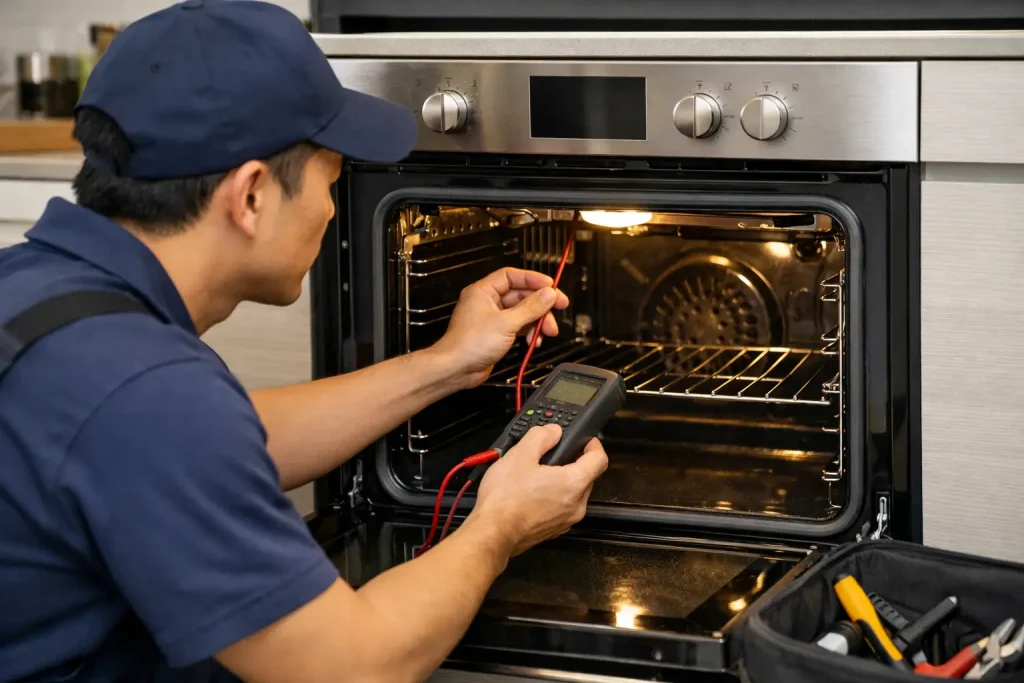
A professional diagnosis starts with the symptom pattern, then confirms it with testing. That usually includes checking which function causes the trip, inspecting heating elements, examining internal wiring and terminals, and testing for insulation or earth leakage issues.
Not every oven trip leads to a major repair. Sometimes the issue is isolated to one failing element or one damaged connection. In other cases, the fault is less straightforward because more than one part has been affected by heat over time. That is why clear testing matters. Replacing parts without confirming the cause can waste both time and money.
For landlords and property managers, this is especially important. A recurring fault is frustrating for tenants and costly if the wrong part is replaced first. For commercial users, speed matters, but so does accuracy. The aim is to restore reliable operation, not just get the oven running for one more day.
Repair or replace depends on the fault
Most oven trip issues are repairable, especially when the oven is otherwise in good condition and the fault is limited to a component such as an element, wiring section, or terminal connection. This is often the most cost-effective outcome.
Replacement becomes a more realistic option when the oven has multiple failing parts, severe internal heat damage, or poor parts availability. Age alone does not decide it. Condition, fault severity, and repair value matter more.
That is where honest advice makes a difference. A proper assessment should tell you whether the repair is sensible, what parts are involved, and what to expect next. For many customers, that clarity is just as important as the repair itself.
What Singapore customers should keep in mind
In Singapore, ovens are used in a wide range of settings, from compact home kitchens to busy food businesses. The urgency is different for each case, but the need is the same: fast diagnosis and dependable repair. If an oven keeps tripping in a home, it disrupts daily cooking. If it happens in a cafe or restaurant, it can affect service immediately.
It also helps to remember that built-in ovens can hide faults behind cabinetry and fixed connections. What looks like a simple power issue may involve heat-damaged terminals, internal component failure, or a fault that only appears under load. That is why on-site diagnosis matters. The appliance has to be assessed in its actual installation environment.
Fix It Appliance handles these faults with a straightforward approach: identify the real cause, explain the repair clearly, and restore safe operation as quickly as possible.
When to call for service
If the oven trip happens more than once, especially under the same heating conditions, it is time to stop treating it as a one-off. The stronger the pattern, the more likely there is a real internal fault.
The most useful details to share during service booking are simple: whether the trip happens immediately or after heating, whether it affects one cooking mode or all modes, and whether the rest of the property power stays stable. That information can speed up diagnosis and reduce downtime.
An oven should heat consistently without cutting power to the circuit. If it cannot do that, the issue is no longer about inconvenience. It is about safety, reliability, and getting the appliance back to proper working condition with a repair you can trust.