
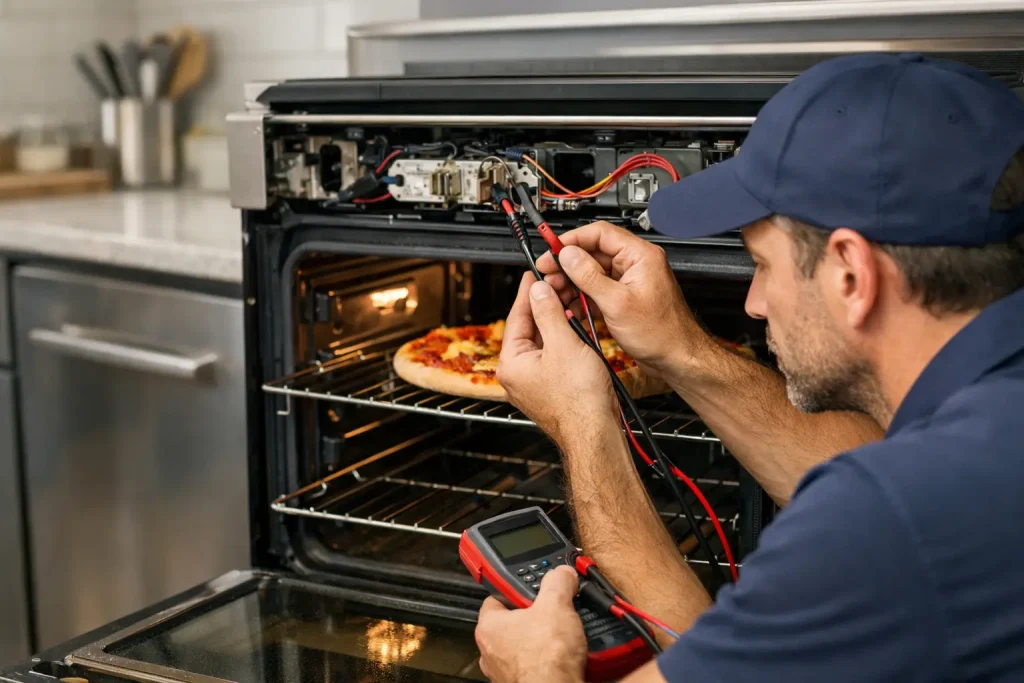
A cake that remains wet in the center, food that burns at the edges, or an oven that takes far too long to heat can point to a temperature-control problem. This oven thermostat fault guide explains what those symptoms can mean, what you can safely check, and when an oven repair technician should test the appliance.
A thermostat fault is common, but it is not the only explanation for incorrect oven temperatures. Modern built-in ovens may use an electronic temperature sensor and control board rather than a traditional mechanical thermostat. A correct diagnosis prevents unnecessary parts replacement and helps restore reliable cooking temperatures.
What an oven thermostat does
The thermostat regulates heat inside the oven cavity. Once you set a temperature, it signals the heating elements to switch on and off as needed to maintain that setting. The oven will naturally cycle above and below the selected temperature by a small amount. It should not, however, swing so widely that cooking results become unpredictable.
In older ovens, the thermostat is often a mechanical component connected to the temperature dial. In many newer electric ovens, the temperature sensor reads the cavity temperature and sends information to an electronic control board. Both systems can create similar symptoms when they fail, so the visible problem alone does not confirm which part is at fault.
A thermostat problem can also be confused with a weak bake element, faulty grill element, damaged fan motor, door seal issue, loose wiring, or a control board fault. That is why testing matters before ordering a replacement part.
Signs of an oven thermostat fault
The most noticeable sign is an oven that does not cook at the set temperature. You may select 350°F, for example, but the oven may run much cooler, overshoot badly, or heat inconsistently from one use to the next.
Food results often provide useful clues. If the bottom of dishes burns while the top stays pale, the issue could be excessive lower-element heat, poor air circulation, or incorrect temperature control. If everything takes longer than expected, the oven may not be reaching temperature or one heating element may not be operating correctly.
Other common warning signs include:
- The oven overheats and continues heating well beyond the selected setting.
- It switches off before food is properly cooked, even after a full preheat cycle.
- The temperature display or dial setting does not match the actual oven temperature.
- Cooking is uneven across shelves or from one side of the oven to the other.
- The oven works intermittently, especially after it has been hot for some time.
An oven that overheats deserves prompt attention. Excessive temperature can damage internal components, scorch cookware, and create a safety concern. Turn the appliance off and avoid further use until the cause is checked.
How to check oven temperature safely
A basic oven thermometer can help confirm whether there is a genuine temperature issue. Place it on the center rack, set the oven to a commonly used temperature, and allow sufficient time for preheating and several heat cycles. Do not judge performance only by the first temperature reading. Ovens cycle on and off, so a brief rise and fall is normal.
Check the thermometer after around 20 to 30 minutes. If it consistently reads significantly higher or lower than the setting, record the difference. Repeat the check on another day if possible. This gives a technician more useful information than a single result, especially where the fault is intermittent.
Keep the oven door closed during testing. Opening it repeatedly releases heat and can make a normal oven appear inaccurate. Avoid placing the thermometer directly against a wall, element, or fan cover, as these areas may not represent the average cavity temperature.
For ovens with an electronic display, check whether the manufacturer allows temperature calibration through the settings menu. Some models permit a small adjustment to compensate for a consistent difference. Calibration is suitable only when the oven is otherwise heating steadily. It will not fix a failed sensor, damaged element, or faulty control board.
Oven thermostat fault guide: thermostat or another problem?
A mechanical thermostat is more likely to be at fault when an older oven has a temperature dial and repeatedly runs too hot or too cool across all cooking functions. The thermostat contacts may wear over time, causing the heat to cut out too early or remain on too long.
With newer built-in ovens, the temperature sensor is often the more likely suspect. This small probe inside the oven cavity can become inaccurate, develop an electrical fault, or have damaged wiring. The control board may then receive the wrong temperature reading and regulate the elements incorrectly.
Heating elements can produce similar symptoms
A partially failed bake element may still glow or warm up, but it may not produce enough heat to reach the selected temperature. A damaged grill element can cause poor browning or weak upper heat. In fan ovens, a faulty fan motor can leave heat concentrated in one area, making the oven seem inaccurate even when the thermostat is working.
Visible blistering, cracks, or burn marks on an element are strong signs of damage. Still, some element faults cannot be identified by sight. Professional testing can check continuity, insulation condition, wiring connections, and whether the control system is supplying power correctly.
Door seals and airflow also matter
A worn or loose door gasket allows heat to escape. The oven may take longer to preheat and struggle to hold its temperature, particularly during longer cooking cycles. Fan oven problems can also affect heat distribution. These faults are usually less likely to cause extreme overheating, but they can result in uneven cooking and wasted energy.
When to stop using the oven
Do not continue testing the appliance if you notice a burning smell, smoke, sparking, tripped circuit breaker, melted control knob, or an oven that will not switch off. Switch it off at the appliance isolator if it is safe to do so. Do not dismantle a hardwired built-in oven or attempt live electrical tests.
Replacing a thermostat, sensor, or control component may appear straightforward online, but oven parts are model-specific. Incorrect parts, loose connections, or damaged insulation can lead to repeated faults. Built-in ovens also need careful removal and reinstallation to avoid damaging the cabinet, door, or electrical connections.
Repair options and likely cost factors
The repair cost for an oven thermostat fault depends on the appliance brand, model, age, fault type, and part availability. A straightforward sensor or thermostat replacement is usually less complex than a control board repair. However, access can vary substantially between freestanding ovens, built-in ovens, and commercial units.
A proper diagnostic visit should identify whether the problem comes from the thermostat, sensor, heating element, fan, wiring, or control board before parts are replaced. This is particularly valuable when an oven has more than one symptom, such as poor heating and a fan that is noisy or slow.
For homeowners, tenants, landlords, and commercial kitchens in Singapore, repair is often worthwhile when the oven is otherwise in good condition and a common replaceable part is responsible. Replacement may make more sense if the appliance has several major faults, critical parts are unavailable, or the repair cost is high relative to an aging unit’s remaining life.
Fix It Appliance can diagnose oven and built-in oven temperature faults, explain the repair options clearly, and replace suitable spare parts where needed. An honest diagnosis is the best starting point, especially when the fault may not be the thermostat itself.
Preventing repeat temperature problems
Use oven trays and cookware that allow air to circulate, and avoid blocking fan vents. Do not force the oven door closed if a tray is misaligned, as this can damage the door seal or hinges. Clean spills once the appliance has cooled, particularly around the cavity floor and heating elements, because burnt residue can cause smoke and make it harder to spot developing faults.
If cooking results begin changing gradually, test the temperature early rather than waiting for a complete failure. A timely inspection can prevent a minor sensor, element, or connection issue from developing into a more expensive control-system repair. Reliable oven temperature is not just about better cooking results – it is a sign that the appliance is operating as it should.


