A dishwasher that leaves grit on glasses or gives off a stale smell is often telling you something simple: its filter is clogged. Learning how to clean dishwasher filter parts correctly can improve washing results, reduce odors, and help prevent unnecessary strain on the drain system. It is a straightforward job for most homeowners, but forcing a stuck filter or reassembling it incorrectly can create a bigger problem.
Why Your Dishwasher Filter Needs Regular Cleaning
The filter sits at the bottom of the dishwasher, usually beneath the lower spray arm. Its role is to catch food particles, broken bits of crockery, labels, and other debris before they reach the drain pump. When it is clean, water can circulate and drain properly. When it is blocked, dirty water and food residue may be recirculated onto your dishes.
In Singapore, frequent dishwasher use, humid conditions, and food scraps left on plates can cause buildup faster than many people expect. Grease, rice grains, seeds, coffee grounds, and small pieces of packaging are common causes of blockage. Even a dishwasher that appears to be running normally may be washing less effectively because the filter is partially restricted.
Most household dishwashers benefit from a filter check once a month. Clean it more often if the appliance is used daily, handles oily cookware regularly, or serves a busy household, office pantry, cafe, or other commercial setting. The right interval depends on usage, not just the age of the machine.
How to Clean Dishwasher Filter Step by Step
Start only when the dishwasher is switched off and has finished its cycle. If the machine has recently been used with a hot wash program, allow the interior to cool first. For extra safety, turn off the dishwasher at its power source before working inside it.
Remove the Lower Rack and Locate the Filter
Pull out the lower rack and set it aside. At the base of the tub, you will usually see a round, cylindrical filter assembly, a flat mesh screen, or both. The exact design varies by brand and model. Some filters twist counterclockwise to release, while others have a handle, tab, or locking mechanism.
Check your appliance manual if the filter does not come out easily. Do not use a screwdriver, knife, or excessive force to pry it loose. Plastic locking tabs can break, and replacement parts may not be immediately available for every dishwasher model.
Take Out the Filter Carefully
Turn or lift the filter according to its design, then remove the mesh screen if it is separate. Keep the parts close together and note their orientation before cleaning. This makes reassembly easier, especially where the filter has several pieces.
Look into the filter housing once the assembly is removed. You may find food particles, broken glass, fruit pits, toothpicks, or small pieces of plastic. Remove loose debris carefully by hand. If there is broken glass, wear protective gloves and use a torch or phone light to inspect the area properly.
Rinse Away Loose Residue
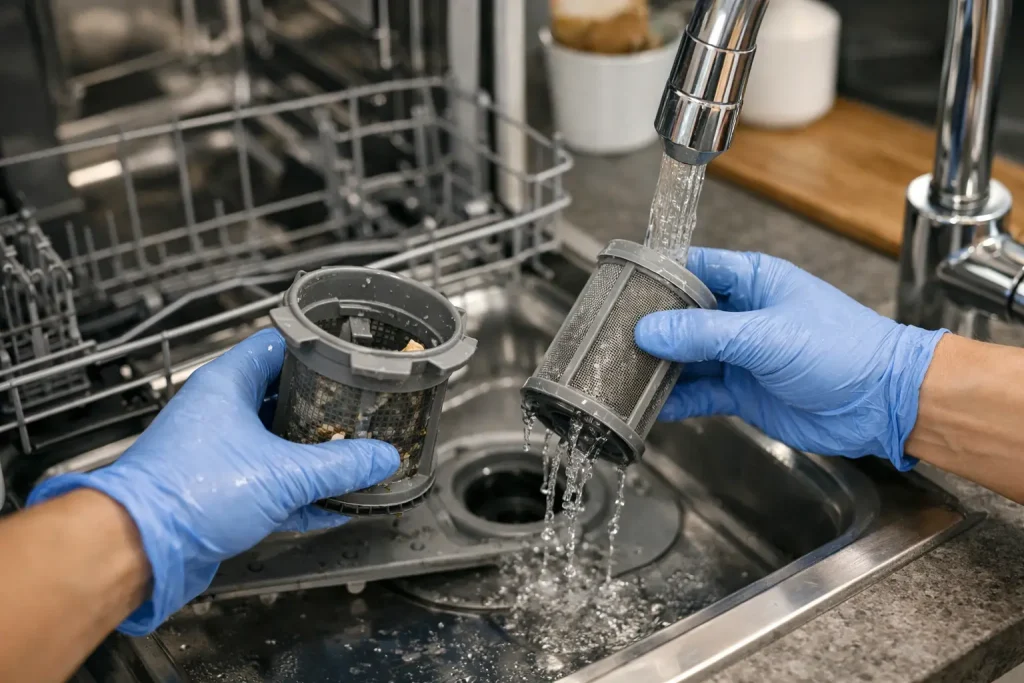
Hold the filter under warm running water. A soft dish brush or old soft toothbrush can help remove residue from the fine mesh and grooves. Brush gently, particularly around the mesh, as pressing too hard can deform it.
For normal buildup, warm water and a small amount of mild dishwashing liquid are enough. Avoid strong degreasers, bleach, abrasive powders, and wire brushes. These can damage plastic components, weaken seals, or leave residues that affect later wash cycles.
If grease has hardened on the filter, soak it in warm soapy water for 10 to 15 minutes before brushing. Do not soak electronic components, sensors, or parts that were not designed to be removed. In most dishwashers, the removable filter itself is purely mechanical, but it is still best to clean only the parts identified in the manual.
Clean the Filter Well and Drain Area
Wipe the filter well with a damp cloth to remove loose sludge around the opening. Check that no debris is sitting near the drain cover or pump inlet. A small amount of water at the bottom is not always a fault, but dirty standing water, thick residue, or a strong odor suggests the dishwasher needs further attention.
Do not reach deeply into the drain area or remove covers that are not intended for routine cleaning. Some machines have a pump cover that can be opened, but the procedure differs by model. Incorrect removal can damage clips or seals and may allow an object to enter the pump.
Refit the Filter Securely
Place the screen and filter back in their original positions. Turn or lock the assembly until it is fully secure. It should sit level and not lift out easily. A filter that is not properly locked can allow debris into the pump or interfere with water circulation.
Return the lower rack, restore power, and run a short rinse cycle. Listen for unusual noises and check that water drains away at the end. If the dishwasher still has poor cleaning performance, the filter may not be the only issue.
Signs a Dirty Filter Is Affecting Your Dishwasher
A blocked filter does not always stop a dishwasher completely. More often, it causes gradual changes in performance. Dishes may come out with grains or residue, glasses may look cloudy, and the interior may have a sour or greasy smell. You may also notice water collecting at the bottom of the tub after a cycle.
Other warning signs include a gurgling drain sound, weaker spray action, longer cycles, or an error code related to drainage. These symptoms can also be caused by a blocked drain hose, faulty drain pump, worn impeller, clogged spray arms, or a circulation problem. Cleaning the filter is the sensible first check, but it is not a cure for every dishwasher fault.
What Not to Do When Cleaning a Dishwasher Filter
Avoid rinsing large amounts of loose food waste directly down into the dishwasher sump. Remove it first, rather than pushing it toward the drain. It is also best not to run the dishwasher without its filter, even for one cycle. The filter protects internal components from debris that can damage the pump.
Vinegar is sometimes used for odor control, but it should not be treated as a solution for a mechanical blockage. Used occasionally and in the correct amount, it may help with light mineral residue. Used repeatedly or mixed with other cleaners, it can be less helpful and may affect some rubber parts over time. For persistent grease, sludge, or poor drainage, physical cleaning and proper diagnosis are more reliable.
Do not assume every dishwasher has the same filter design. Some models have self-cleaning filtration systems, while others have manual filters that require regular attention. If you cannot identify the filter or access it safely, stop rather than dismantling unfamiliar parts.
When Filter Cleaning Is Not Enough
Call for dishwasher repair if the filter is clean but water still does not drain, the dishwasher hums without pumping out, or there is a burning smell, leak, repeated error code, or loud grinding noise. These can indicate a foreign object in the pump, a damaged impeller, a drain pump fault, or an electrical issue that should not be handled as a DIY repair.
Professional diagnosis is also useful when the filter repeatedly fills with unusual debris despite careful loading. A damaged rack, loose spray arm component, deteriorating internal part, or drainage issue may be contributing to the problem. For landlords and businesses, resolving the cause early can help avoid downtime and water damage.
Fix It Appliance provides dishwasher diagnostics and repair across Singapore when cleaning and basic maintenance do not restore normal performance. A technician can assess the filter system, drain pump, hoses, spray arms, seals, and related components before recommending the appropriate repair.
A clean filter takes only a few minutes, yet it protects one of the dishwasher’s most hardworking systems. Make it part of your regular appliance care routine, and treat persistent drainage or cleaning problems as a reason to investigate further rather than repeatedly running another cycle.