
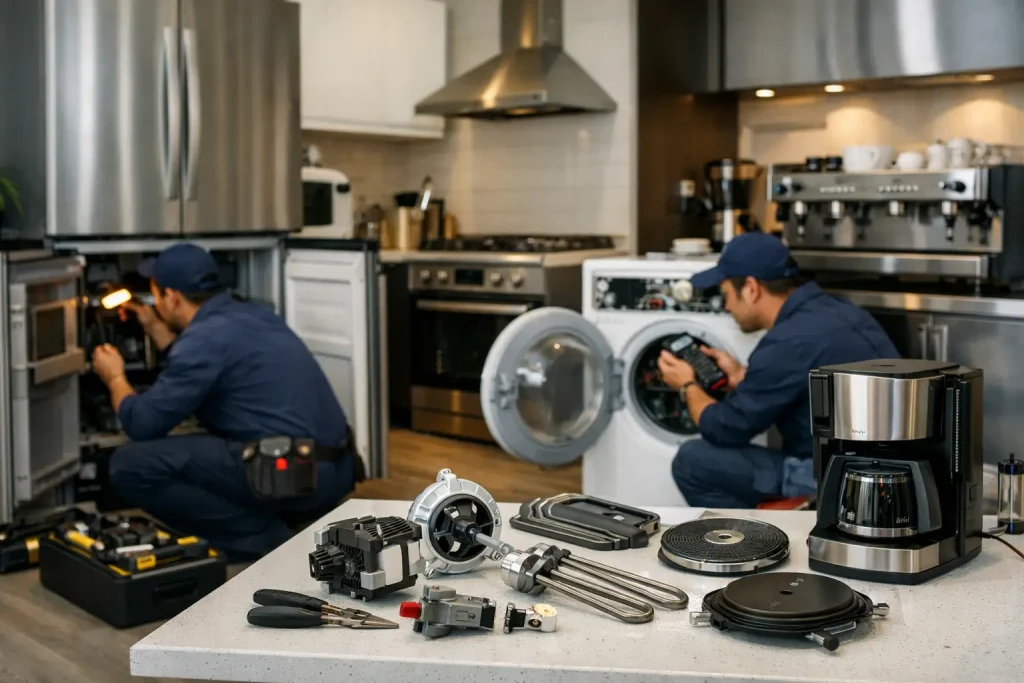
A refrigerator that runs but does not cool, a washer that will not drain, or an oven that heats unevenly often points to one worn component rather than a failed appliance. This appliance parts replacement guide helps Singapore homeowners and businesses understand what may be wrong, how to identify the correct part, and when professional replacement is the safer choice.
Replacing the right part can restore performance and extend an appliance’s useful life. Replacing the wrong one can waste money, create a new fault, or damage the appliance further. The goal is not to change parts until something works. It is to diagnose the cause first.
Appliance Parts Replacement Guide: Start With the Fault
A symptom is useful, but it is not a diagnosis. For example, water under a washing machine could come from a loose inlet hose, a worn door seal, a damaged drain pump, or too much detergent. A refrigerator that feels warm may have blocked airflow, dirty condenser coils, a faulty fan motor, a defective thermostat, or a compressor-related issue.
Before ordering a spare part, note exactly what the appliance does and when it happens. Does the dishwasher stop midway through a cycle? Does the dryer tumble but produce no heat? Does the induction cooktop show an error code? These details help narrow the fault and prevent unnecessary replacements.
Start with simple checks that do not require dismantling. Confirm the appliance has power, the outlet or circuit has not tripped, and the controls are set correctly. Check for visible damage, loose doors, clogged filters, blocked vents, or drainage issues. If there is a burning smell, sparks, repeated tripping, gas odor, or leaking water near electrical components, stop using the appliance and arrange a professional inspection.
Find the Exact Model and Part Number
Appliance parts are rarely interchangeable just because they look similar. A heating element for one oven model may have different connectors, wattage, mounting points, or temperature specifications from another. Even two appliances from the same brand can use different components.
Find the appliance model number before searching for a replacement. The rating label is commonly located inside a refrigerator compartment, around the washing machine door opening, behind a dryer door, on the side of an oven frame, beneath a cooktop, or at the back of the appliance. Record the full model number, serial number, and product code if shown.
The part number is even more useful. It may be printed on the component itself, listed in a parts diagram, or confirmed during a technician’s diagnosis. Do not rely only on photos from online listings. A part can appear identical while having incompatible wiring, dimensions, software configuration, or safety ratings.
For built-in ovens, cooktops, cooker hoods, and integrated dishwashers, correct identification matters even more. These appliances may require specific brackets, panels, wiring harnesses, or installation settings. An unsuitable part can affect fit, ventilation, or safe operation.
Common Appliance Parts That Need Replacement
Some parts wear naturally with heat, movement, moisture, and regular use. Others fail because of power fluctuations, blocked airflow, poor maintenance, or age. The following faults are common, but each should still be confirmed before a part is replaced.
Refrigerator, freezer, and wine chiller parts
Cooling appliances often develop problems with door gaskets, evaporator fan motors, condenser fan motors, thermostats, defrost heaters, thermal fuses, sensors, and control boards. A torn gasket allows warm humid air into the compartment, leading to poor cooling, excess frost, and longer running time. A fan motor fault may cause uneven temperatures or a refrigerator that is cold in one section but warm in another.
Compressor and sealed-system problems are different. They can be more costly and require specialized tools and experience. Replacing a fan or sensor may be practical, while a compressor repair depends on the appliance’s age, condition, parts availability, and the overall repair cost.
Washing machine and dryer parts
Washing machines commonly need replacement drain pumps, inlet valves, door locks, suspension components, belts, hoses, and rubber door seals. A machine that will not spin may have a load-balance issue, but it can also involve the lid switch, motor system, drain pump, or control board. Replacing a belt without checking why it came off may only delay the real repair.
For dryers, common parts include heating elements, thermal fuses, thermostats, drive belts, drum rollers, door switches, and motors. A dryer that runs but stays cold may have a failed heater or thermal fuse, but restricted ventilation can also cause overheating and repeat failures. The underlying airflow issue must be corrected before fitting a new heating component.
Oven, cooktop, and dishwasher parts
Ovens may require heating elements, temperature sensors, cooling fans, door hinges, seals, selector switches, or control boards. Uneven cooking can result from a weak element, a faulty sensor, or a fan issue in a convection oven. Temperature complaints should be checked carefully because the problem may be calibration rather than a completely failed part.
Induction cooktops, ceramic hobs, and gas hobs need extra caution. Their internal electronics, glass surfaces, and gas connections should not be handled as a general DIY repair. Gas valves, igniters, burner assemblies, and ignition modules must be fitted correctly to avoid safety risks.
Dishwashers frequently need drain pumps, circulation pumps, inlet valves, door latches, spray arms, seals, or heating components. If dishes remain dirty, do not assume the pump has failed. Blocked spray arms, filter debris, low water intake, and incorrect loading can produce similar results.
Choose Genuine, OEM, or Compatible Parts Carefully
Genuine parts are supplied by the appliance brand or its authorized source. OEM parts are made by the original manufacturer or to the original specification, while compatible parts are third-party alternatives designed to fit a particular model.
A compatible part can be a sensible option for straightforward components such as some filters, gaskets, or hoses, provided its fit and specifications are verified. For control boards, sensors, heating components, motors, door locks, and safety devices, the lowest-priced option is not always the best value. Poor-quality parts may fail early, fit poorly, or create error codes.
Consider the total cost, not only the part price. A cheaper component that requires another service visit can cost more than a correctly matched, reliable spare part installed once. For commercial appliances, downtime also matters. A café ice maker, office refrigerator, or laundry machine may justify a higher-quality replacement because disruption affects daily operations.
When DIY Replacement Makes Sense
Simple, low-risk tasks can be manageable for a confident owner who follows the appliance manual. Replacing a refrigerator water filter, fitting a compatible light bulb, cleaning a filter, or changing an easily accessible shelf or drawer are usually straightforward.
More complex work needs proper diagnosis and safe handling. Appliances contain high-voltage components, sharp metal panels, stored electrical charge, hot surfaces, moving parts, and water connections. Microwave ovens are particularly hazardous because they can retain a dangerous electrical charge even after being unplugged. Built-in appliances can also be heavy and difficult to remove without damaging cabinetry or flooring.
Do not attempt to bypass a thermal fuse, door switch, safety interlock, or sensor to keep an appliance running. These components are designed to protect the appliance and the people using it. If a replacement part fails again soon after installation, that is a clear sign that another fault needs to be diagnosed.
Repair or Replace: Make the Decision on Facts
Parts replacement is usually worthwhile when the appliance is otherwise in good condition, the required part is available, and the repair cost is reasonable compared with replacement. A relatively new refrigerator with a failed fan motor or a washing machine with a worn door seal can often be repaired effectively.
Replacement may be more practical when several major parts are failing, the appliance has severe corrosion or structural damage, or an expensive sealed-system or control issue affects an older unit. Availability is also a factor. Some discontinued models have limited parts support, making future repairs less predictable.
A professional diagnosis gives you the information needed to decide. Ask what part has failed, why it failed, whether related issues were found, and whether the replacement part carries a service warranty. Honest service means explaining the repair option clearly, including cases where replacement is the more sensible choice.
Prevent Repeat Part Failures
Many replacement parts last longer when the appliance is maintained properly. Keep refrigerator vents clear, clean accessible condenser areas as recommended, and check door seals for gaps. Remove lint from dryer filters after each use and keep the ventilation path clear. Clean washing machine filters where applicable, avoid overloading, and inspect inlet and drain hoses periodically.
For dishwashers, clean filters and spray arms regularly. For ovens and cooktops, avoid allowing spills to build up around controls, fans, burners, or door seals. Use appliances within their intended load and temperature limits. Small maintenance habits reduce strain on motors, pumps, heaters, and sensors.
When a fault is unclear or the repair involves internal electrical, gas, cooling, or built-in components, professional help is the practical next step. Fix It Appliance can diagnose the fault, source suitable spare parts, and carry out reliable repairs across Singapore so you can use your appliance with confidence again.


