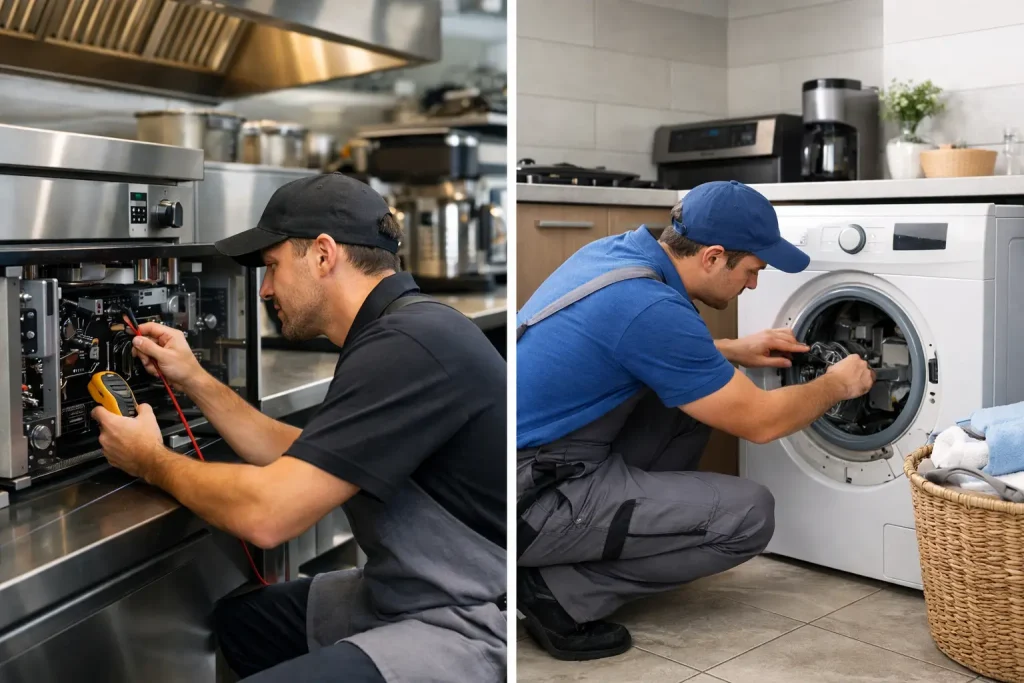
A walk-in cooler failing at a cafe before lunch service is a very different problem from a refrigerator acting up in a family kitchen. That is the real difference behind commercial vs residential appliance repair. Both involve diagnosing faults, replacing parts, and getting equipment working again, but the expectations, risks, and repair process are not the same.
For homeowners, tenants, landlords, and business operators, that distinction matters. The wrong repair approach can lead to repeat breakdowns, wasted money, lost stock, or extended disruption. If you are deciding what kind of service you need, it helps to understand where the differences begin and why they affect cost, timing, and results.
What commercial vs residential appliance repair really means
Residential appliance repair focuses on equipment used in homes and apartments. That usually means refrigerators, washing machines, dryers, ovens, and cooker hoods designed for everyday household use. The workload is moderate, usage patterns are predictable, and the repair goal is usually to restore convenience as quickly as possible.
Commercial appliance repair deals with equipment used in business settings such as restaurants, cafes, offices, rental properties, and shared facilities. These appliances often run longer hours, serve more people, and operate under tighter performance demands. A failure may not just be inconvenient. It can interrupt business, affect food safety, delay operations, or create complaints from customers or tenants.
That is why commercial repair work tends to involve more urgency, heavier-duty components, and stricter expectations around uptime.
Why the repair process is different
At first glance, a fridge is a fridge and an oven is an oven. In practice, commercial models are usually built for higher output, more frequent use, and faster recovery times. They may have larger compressors, stronger motors, more complex control systems, or specialized temperature requirements.
Residential units are generally simpler in design and easier to fit into a standard service visit. Parts are often more widely available, and the use case is easier to understand. A technician can often diagnose the issue based on common wear patterns seen in home appliances.
Commercial units are less forgiving. A coffee machine in a busy cafe, a freezer in a food business, or a shared laundry machine in a managed property can fail under constant pressure. Repairs often need closer inspection because the cause may involve usage volume, installation conditions, ventilation issues, or accelerated wear from daily operation.
Response time and urgency
This is one of the biggest differences in commercial vs residential appliance repair.
When a home washing machine stops draining, it is disruptive. Laundry piles up, routines are interrupted, and frustration builds quickly. But in most homes, the problem can wait a short time for proper diagnosis and repair.
When a commercial refrigerator stops holding temperature, every hour matters. Stock can spoil. Health standards may be affected. Staff may not be able to work normally. The cost of delay can quickly exceed the repair bill itself.
That does not mean residential customers should accept slow service. It means commercial service usually carries a higher urgency because the impact of downtime is broader and more expensive. A good repair company understands that difference and plans accordingly.
Cost differences and what drives them
Many customers assume commercial repair is simply the same job with a bigger invoice. Sometimes it is more expensive, but not for arbitrary reasons.
Commercial repairs often cost more because the appliances themselves are larger, the components are heavier-duty, and the diagnosis can take longer. Access may also be more complex. In a restaurant kitchen or office pantry, the appliance may be installed in a tight workspace or surrounded by active staff operations. That affects labor time.
Parts can also be more specialized. A residential dryer heating element or refrigerator fan motor may be relatively standard. A commercial unit may require model-specific parts that are not as common or that carry a higher replacement cost.
Residential repairs, on the other hand, can become expensive when the appliance is older, parts are discontinued, or multiple components have started failing at once. So while commercial repair usually trends higher, the real answer depends on the model, fault, and condition of the unit.
Appliance lifespan and wear patterns
Residential appliances are built around normal household cycles. A washing machine may run several times a week. A kitchen oven may be used daily but not continuously. Wear happens gradually.
Commercial appliances usually work much harder. A refrigerator may be opened dozens or hundreds of times a day. A commercial dryer in a shared laundry space may run back-to-back loads. An oven in a food business may spend long periods at high temperature.
Because of that, wear patterns are more aggressive. Seals, motors, thermostats, switches, sensors, and compressors may fail sooner under heavy use. The appliance may still be repairable, but maintenance history and operating conditions matter more in a commercial setting.
Diagnosing the problem is not always straightforward
In residential repair, faults often show up in familiar ways. A washer does not spin, an oven does not heat evenly, or a fridge leaks water onto the floor. These are common issues with common failure points.
Commercial faults can be more layered. An appliance may still run, but not at the required level. A refrigerator may cool, just not enough during peak service hours. A coffee machine may function, but with inconsistent output. A dryer may heat, but take too long to finish each cycle.
That kind of performance issue is harder to judge without understanding the demands placed on the appliance. It is not always about whether the machine turns on. It is about whether it can still do the job reliably.
Choosing the right service for your setting
The safest approach is to match the repair service to the appliance environment, not just the appliance type. Some models exist in both home and business settings, but the service expectations are very different.
For homeowners and tenants, the priority is usually clear communication, honest diagnosis, and a practical recommendation on whether repair makes sense. You want the appliance working again without being pushed toward unnecessary parts or replacement.
For landlords and property managers, speed and accountability matter just as much. A faulty refrigerator or washing machine in a rental unit can lead to tenant complaints and avoidable vacancy friction. Clear reporting and dependable follow-through become part of the service value.
For restaurants, cafes, and offices, downtime is the main concern. You need a repair partner who understands that a faulty appliance is not just a technical issue. It affects operations, staff productivity, and sometimes revenue.
When repair makes sense and when it may not
This is where honest advice matters.
A residential appliance is often worth repairing when the issue is isolated, the unit is still in decent overall condition, and replacement would cost significantly more. The same logic can apply to commercial equipment, especially when the unit is essential to daily operations and the repair can restore dependable performance.
But there are cases where repair may offer only a short-term fix. If the appliance has multiple failing components, repeated service history, or severe wear from age and heavy use, throwing more money at it may not be the best move. A trustworthy technician should say that clearly.
That is especially important with commercial equipment, where repeated downtime can cost more than a replacement decision made at the right time.
Why experience matters more in commercial settings
Any appliance repair should be done carefully, but commercial jobs leave less room for guesswork. Businesses need accurate diagnosis, durable repairs, and realistic expectations about turnaround time. A quick patch that fails again next week is not much of a solution.
That is why service quality matters so much. Transparent pricing, proper troubleshooting, and clear explanation of the fault help customers make informed decisions. In Singapore, where homes and businesses often depend on appliances daily in compact, fast-moving environments, reliable on-site repair makes a real difference.
Fix It Appliance works with both residential and commercial customers, and that balance matters. It means the repair approach can match the real use case, whether that is a family refrigerator, a shared laundry machine, or business equipment that cannot stay down for long.
The better question to ask
Instead of asking whether commercial repair is better than residential repair, ask what the appliance is expected to do and what failure costs you while it is down. That usually leads to the right service decision faster.
A home appliance breakdown is stressful enough. A business appliance breakdown adds pressure by the minute. In both cases, the best repair service is the one that diagnoses the problem honestly, explains the options clearly, and gets the appliance back to reliable working condition with no wasted time.